
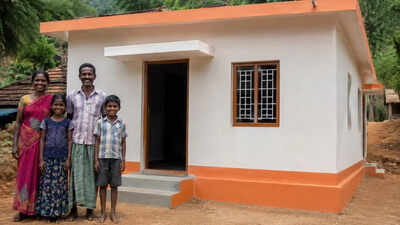
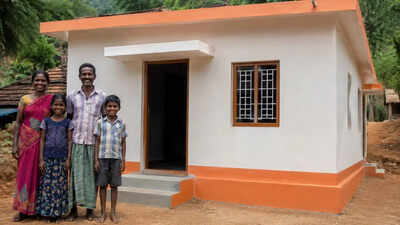
As governments continue to expand housing support schemes offers for people, especially marginalised communities, Tamil Nadu has a free house construction to eligible tribal families under a dedicated welfare scheme. The state government runs a scheme called “Construction of Free Houses for Tribals” under the Adi Dravidar and Tribal Welfare Department.The scheme provides free housing to tribal communities who have already been allocated free house site pattas. Under this program, the state government constructs houses on these lands to ensure that tribals have access to safe and permanent shelter. The scheme is primarily aimed at improving the living conditions of SC/ST communities.The scheme is available only in Tamil Nadu and is an “in kind” benefit, meaning beneficiaries receive a house rather than cash assistance. Direct Benefit Transfer is not applicable to this scheme.
Who is eligible
To qualify for the scheme, applicants must meet three conditions. First, they must be a resident of Tamil Nadu. Second, they must belong to the Scheduled Caste or Scheduled Tribe communities. Third, they must possess a free house site patta. There is no income limit for eligibility. Individuals without a house site patta cannot apply. Non-tribals are not eligible. The scheme is available across all regions of the state for eligible tribal communities.
What are the benefits
The benefit includes free house construction for eligible tribal people. There is no cost to the beneficiary. The government constructs the house at no charge.
How to apply
The application process is entirely offline. There is no online application available. Currently, applications are processed through local government offices such as the Panchayat Union or District Welfare Office.Step one: The interested applicant must collect the application form from the office of the Commissioner, Panchayat Union, District Adi Dravidar and Tribal Welfare Officer, or Commissioner of Tribal Welfare.Step two: In the application form, the applicant must fill in all mandatory fields, paste a passport-sized photograph, and attach self-attested copies of all mandatory documents.Step three: Submit the duly filled and signed application form along with the documents to the concerned office or authority.Step four: Request a receipt or acknowledgment from the concerned authority. The receipt should contain essential details such as the date and time of submission, and a unique identification number if applicable.
Documents required
Applicants must submit proof of identity such as Aadhaar card or any other document as directed by the authority. A caste certificate is required, specifically for Adi Dravidar, Tribal, or Adi Dravidar converted to Christianity. The free house site patta is also mandatory. Address proof is also required. Any other documents may also be required if specified by the authority.
After applying
After verification of the submitted documents, the concerned authorities will inform applicants about the approval of their application. If an application is rejected, applicants may appeal or re-apply after addressing the reasons for rejection.
What problem does this scheme solve?
The scheme’s objective is to address the lack of safe and permanent shelter for tribal individuals in Tamil Nadu. It is most beneficial for tribal individuals who already have house site pattas but cannot afford to build a home. It provides essential housing infrastructure.





Leave a Reply