

Just after halftime in their country’s match against South Africa Thursday afternoon, Mexican embassy officials were nervous.
Forward Julián Quiñones scored a goal in the first nine minutes, and spirits were high at the embassy’s Washington D.C. watch party where mini-burritos, cervezas and — in a nod to the bilateral relationship — McDonald’s hamburgers and walking tacos were flowing freely. But South Africa’s shots on Mexico’s goal were creating staccatos of panic as the score remained 1-0.
“So far, so good — but it could be better,” one diplomat quipped.
Talk to Mexican officials, diplomats and business leaders, and it’s a sentiment that’s apropos of the current state of the bilateral relationship between the U.S. and Mexico as the two countries, along with Canada, kick off six weeks of World Cup festivities.
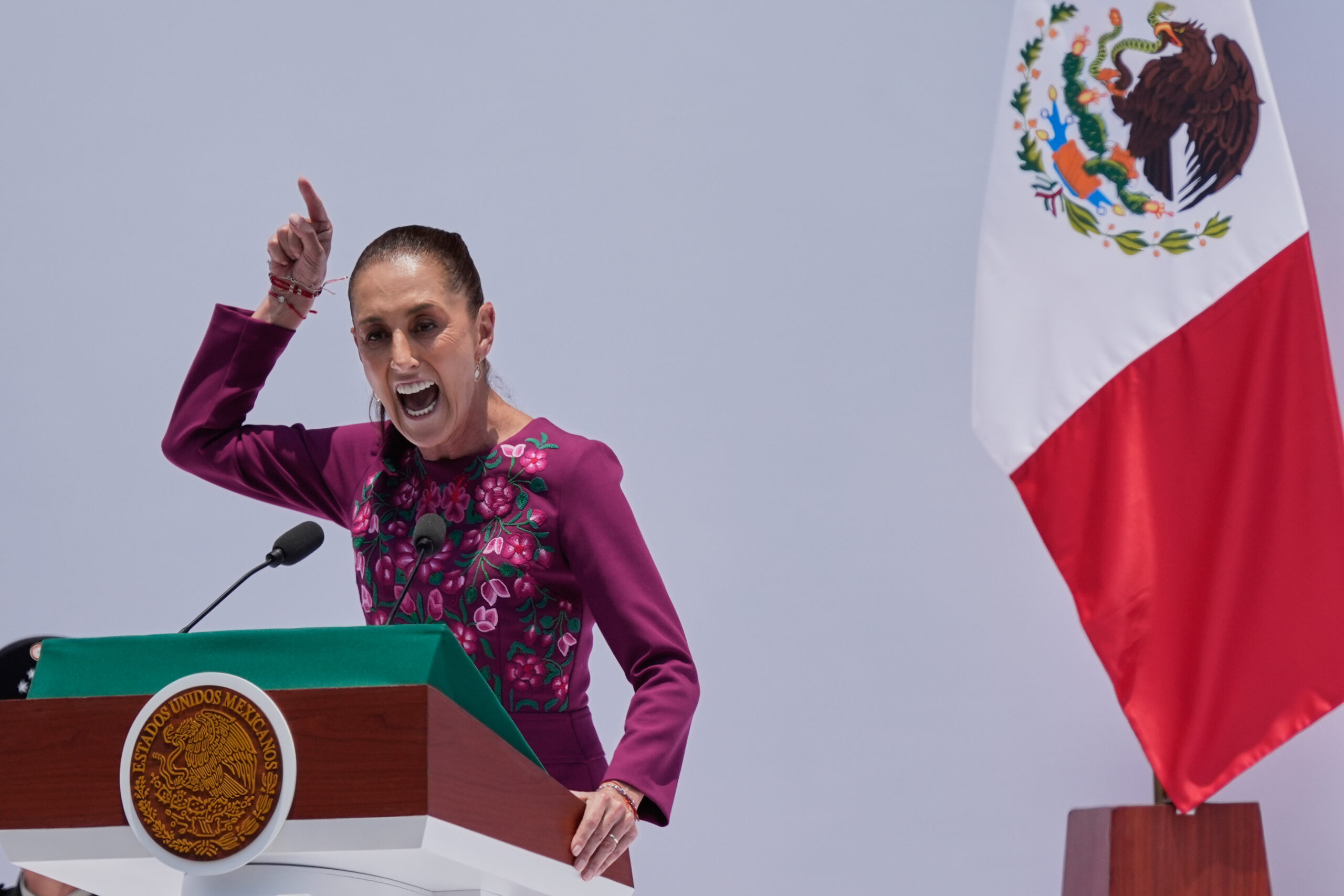
Mexican President Claudia Sheinbaum — who did not attend the opening match — has earned plaudits on both sides of the border for her behind-the-scenes work to cultivate a solid working relationship with President Donald Trump, despite vastly different political orientations and persistent friction over migration, drug trafficking and trade.
Sheinbaum’s domestic challenges were also on full display outside the historic Azteca stadium on Thursday, where hundreds of protestors demanding pay raises for teachers and more resources for the search of 130,000 missing persons in Mexico clashed with police and threw cones and other projectiles into the security perimeter.
Now, at what should be a continental high-water mark — as North America unites to host the World Cup — the relationship is instead facing its greatest test. Tensions are running high over the future of the U.S.-Mexico-Canada trade agreement, a brewing extradition standoff over several Morena party officials — including the governor of Sinaloa — and Trump’s fresh threats on Wednesday to target drugs “coming in by land” via Mexico.
“It’s on a knife’s edge,” said Arturo Sarukhán, Mexico’s ambassador to the U.S. during the Bush and Obama administrations. “The paradox is that all of this is playing out as the World Cup kicks off, a World Cup that should have been a moment to celebrate the promise of North America, and to talk about the future of a North American century.”
The strain on the bilateral relationship beyond the World Cup is existential for Mexico — about 80 percent of the country’s exports flow to the United States — but also for the U.S. Mexico is the United States’ largest trading partner, with two-way trade topping $872 billion in 2025, accounting for roughly 15 percent of all goods coming into the U.S. And the integration runs deep into American supply chains, like autos and electronics, meaning that anything that seriously destabilizes the relationship is bad economic news for the U.S.
For now, the anxiety is largely one-directional, as Trump world remains broadly bullish on the U.S.-Mexico relationship even amid genuine turbulence. Two CIA officers were killed in an April crash in Chihuahua that revealed U.S. intelligence operatives working in the field alongside Mexican state investigators without, Mexican officials say, the federal government’s authorization. The Sinaloa indictments followed just over a week later.
“It’s a pressure point, but I also think if you ask people who work on this, they’d say that — relative to where we’ve been in the past — the security cooperation with Mexico is pretty good under Sheinbaum,” said Alex Gray, a former senior National Security Council official in the first Trump administration. “I think things are, all things considered, not bad.”
Even the original architects of the 2026 World Cup bid, which was won during the first Trump administration, agree that cracks in the U.S.-Mexico relationship were a more serious issue eight years ago.
North American soccer executives told POLITICO that bringing the U.S. together with Mexico wasn’t easy at a time when Trump was calling NAFTA — the precursor to USMCA — “a disaster” and demanding Mexico pay for his border wall.
White House aides laud Sheinbaum’s cooperation on everything from preventing the spread of Ebola heading into the World Cup to efforts to combat drug trafficking. A senior White House official, granted anonymity to speak candidly about the bilateral relationship, described it simply as “good.”
“I mean, there have been shared responsibilities, like, for example, the whole Ebola thing, right? We worked with them and Canada to ensure that there is proper vetting of individuals coming into the countries,” the official said. “We’re obviously working with her on combatting cartels on many fronts, so it’s good.”
The Mexican embassy in Washington did not respond to a request for comment.
Yet Mexican officials have watched the relationship unfold with a kind of cognitive dissonance, marked by progress in one lane and crisis in another. Homeland Security Secretary Markwayne Mullin’s meeting last month with Sheinbaum in Mexico, for instance, was seen as a positive step for the bilateral relationship, particularly for the security cooperation that has underpinned it.
But that goodwill is being tested on several fronts. The Morena indictments are creating a domestic quagmire for Sheinbaum, who is demanding “overwhelming and irrefutable proof” before moving against Sinaloa Governor Rubén Rocha Moya and the nine other current and former Mexican officials who have been charged by the U.S. Justice Department with drug trafficking and weapons offenses.
Trade talks between the two countries had also been going reasonably well — so much so that the two have been talking without Canada even at the table. But Trump on Wednesday injected a fresh dose of uncertainty by saying he was “not looking to renew” the pact and dismissed the notion that the U.S. needed either of its neighbors. And the countries are all but certain to miss the July 1 date to renew the agreement, with a third round of talks scheduled in Mexico City the week of July 20.
The uncertainty has left proponents of the bilateral relationship nervously reading the tea leaves of Trump’s public appearances for any indication of growing irritation with Sheinbaum.
“What I’m seeing is it’s not just one single relationship: We have several individual and topic-based agendas. You have something very good in one hand and something struggling in the other. What we’re trying obviously is to have an umbrella relationship that is good, that makes the other individual agendas also good,” said Enrique Perret, managing director of the U.S.-Mexico Foundation. “But right now we don’t have that good umbrella relationship. That’s what we’re missing.”
The two leaders still have yet to meet at the White House, a move that some south of the border see as a carefully calculated effort on Sheinbaum’s part to not take any unnecessary gambles with the relationship, and avoid the kind of Oval Office spectacle that became commonplace between Trump and world leaders last year.
The two have only met once in person — at the official draw for the 2026 FIFA World Cup in December. Whether they’ll appear together at any games in the coming weeks remains an open question.






Leave a Reply