
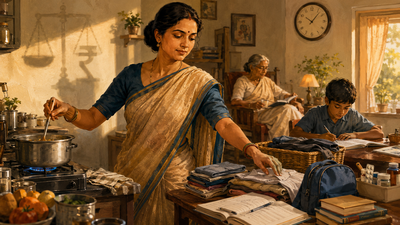
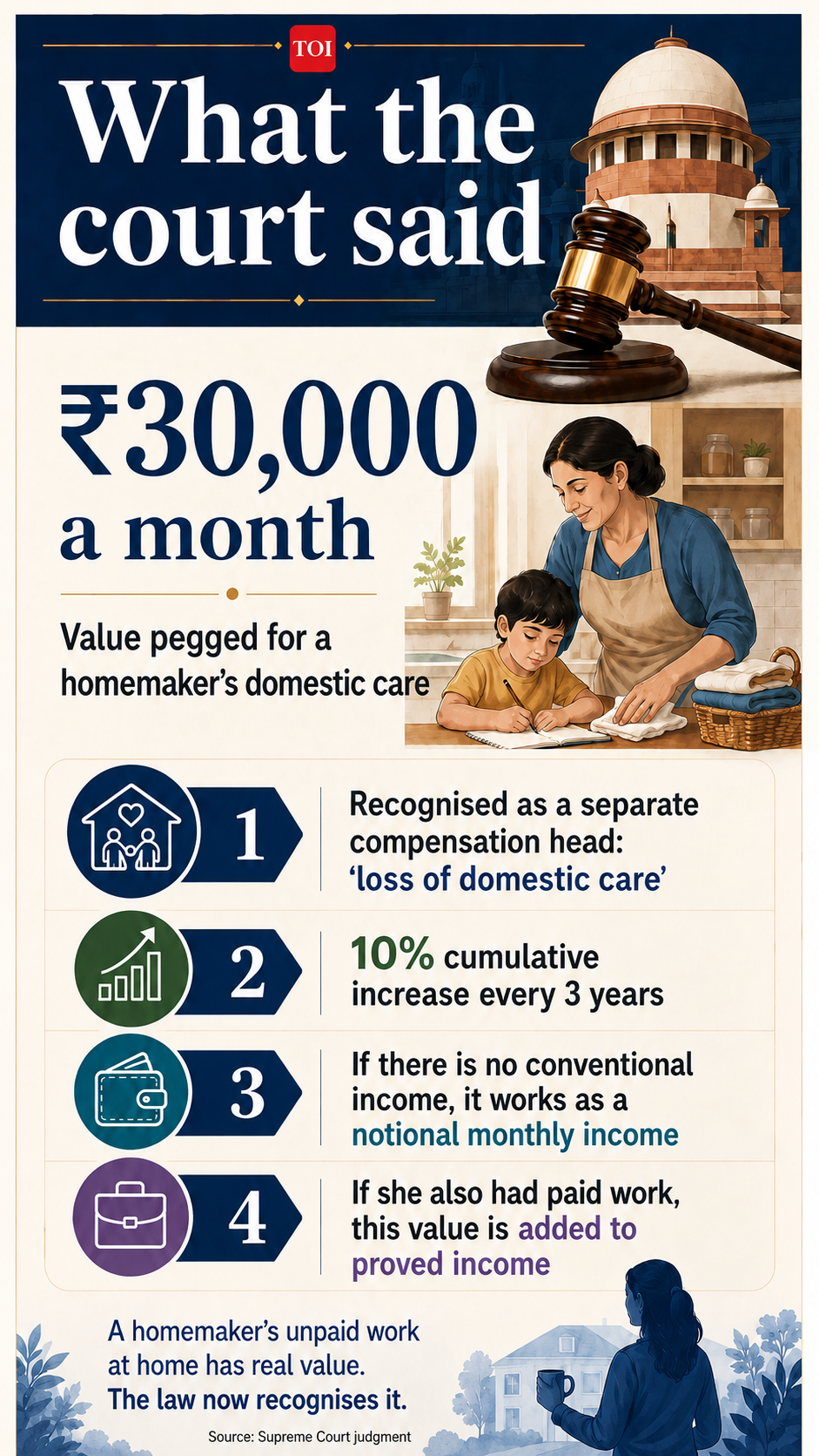
In the Mahabharata’s Yaksha Prashna, Yudhishthira is asked what is heavier than the earth. His answer is the mother.It is one of those civilisational ideas India has carried for centuries that the mother is beyond measure. The woman who holds the home together is beyond ordinary value. She is maa, aai, grihalakshmi, Annapurna. However, in the process of deifying women, the value of their work has often gone under the radar.That is why the Supreme Court’s recent intervention is significant. In a motor accident compensation case, the court recognised “loss of domestic care” as a separate head of compensation for homemakers, pegging it at Rs 30,000 a month, with the amount to be revised upward by 10% cumulatively every three years. Where a homemaker had no conventional monetary income, this would function as a basic notional monthly income. Where she also had paid work, the domestic-care value would be added to her proved income.
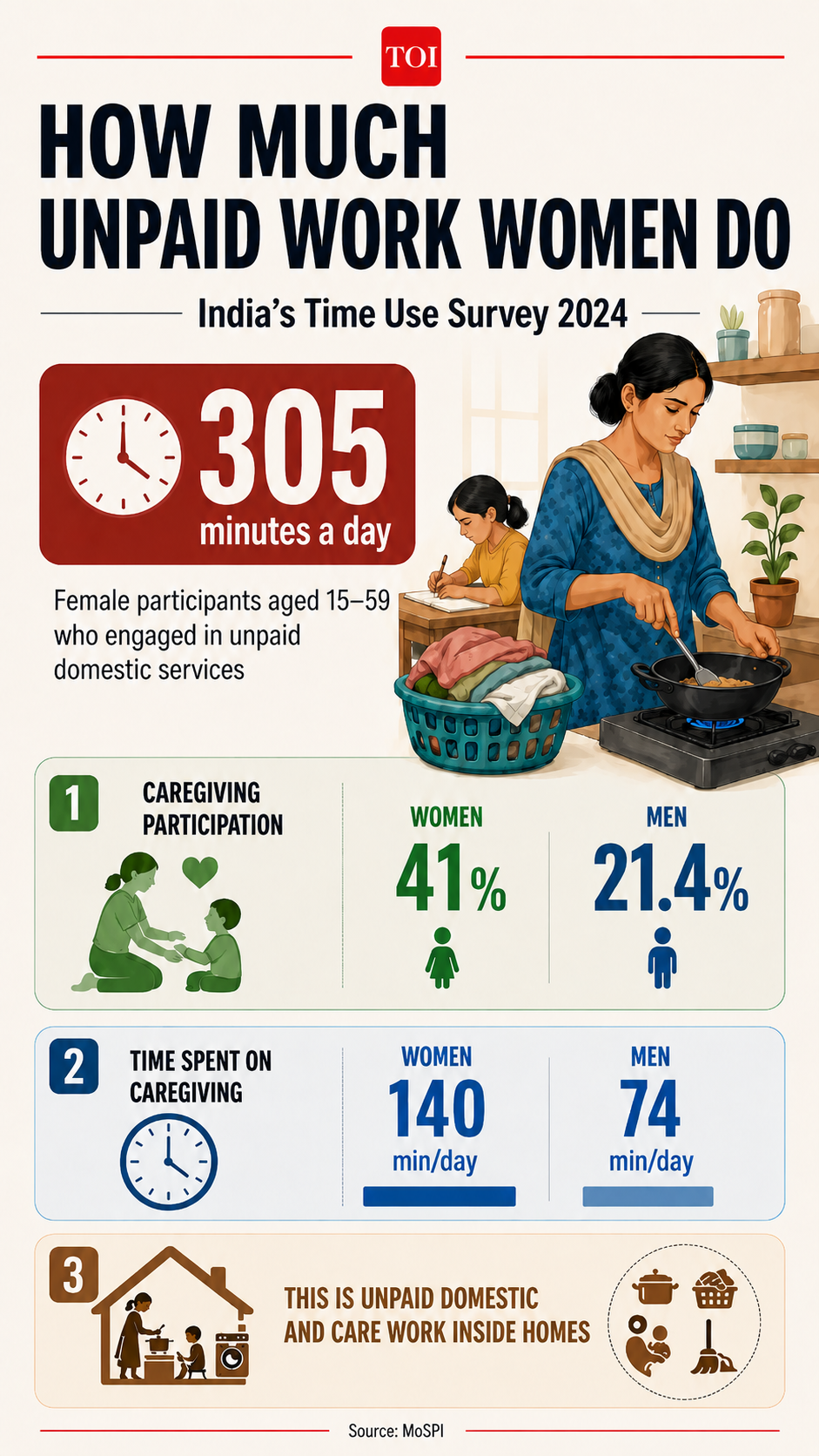
India’s Time Use Survey 2024 gives this labour a quantifiable measure. Female participants aged 15 to 59 who engaged in unpaid domestic services spent about 305 minutes a day on such work. In the same age group, 41% of women participated in caregiving for household members, against 21.4% of men. Women who did caregiving spent about 140 minutes a day on it, compared with 74 minutes for men.
The GDP inside homes
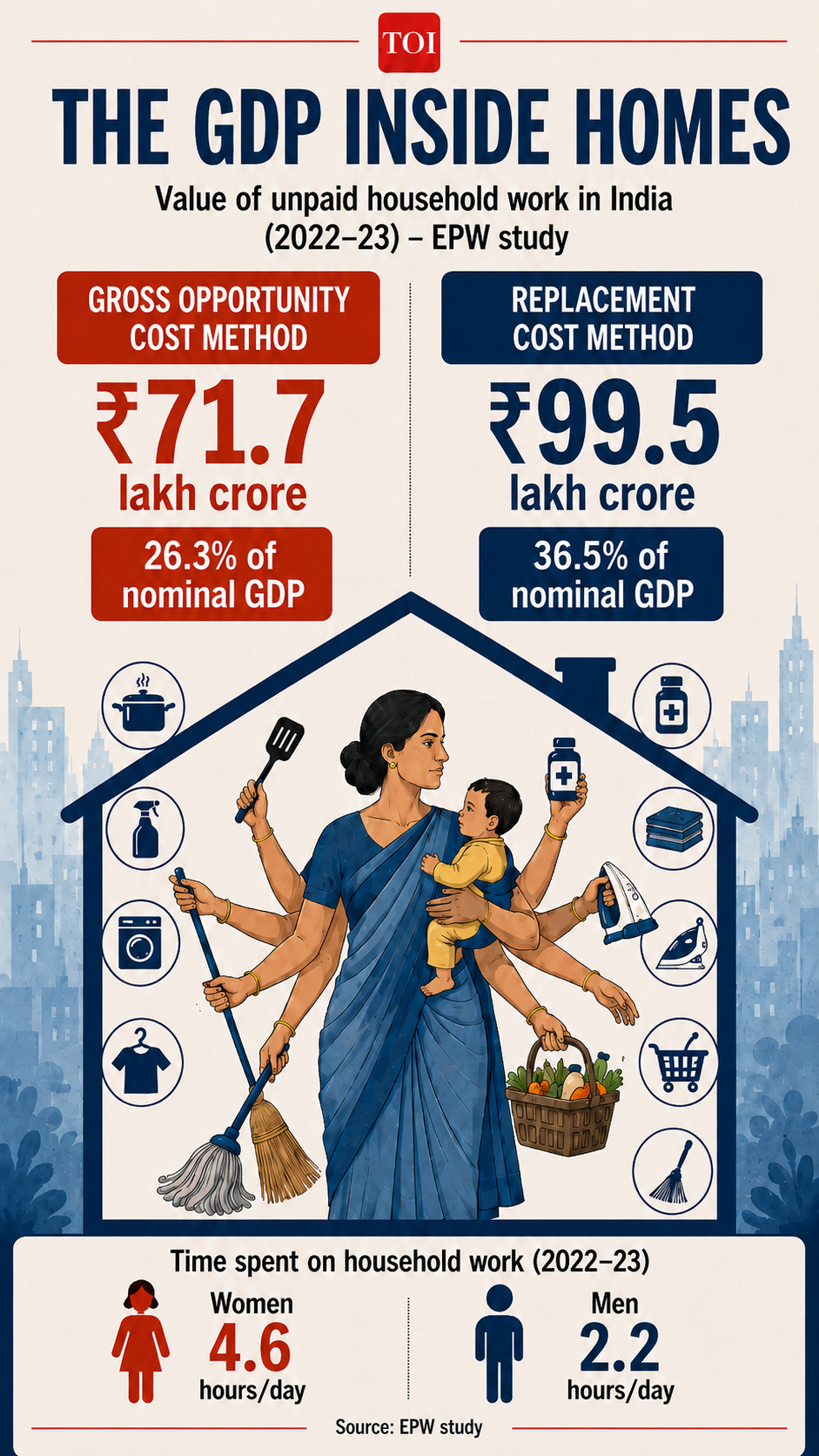
An Economic and Political Weekly paper, “Valuation of Unpaid Household Activities in India”, puts a rupee value to that time. Using CMIE’s Consumer Pyramids Household Survey data from 2019-20 to 2022-23, the authors estimate unpaid household work through two methods.The gross opportunity cost method asks what income people give up when they spend time on household work instead of paid work. The replacement cost method asks what it would cost to hire someone from the market to do comparable tasks. Both methods are imperfect but revealing.For 2022-23, the paper estimates the value of unpaid household work in India at Rs 71.7 lakh crore under the gross opportunity cost method. Under the replacement cost method, it rises to Rs 99.5 lakh crore. As a share of nominal GDP, that is 26.3% in the first method and 36.5% in the second.
These figures do not mean India can increase GDP by simply adding housework to it. The paper adds important caveats. Incorporating unpaid household labour into national accounting would require careful adjustments for wage assumptions, unemployment, labour force participation and demographic factors.Other Indian estimates point in the same direction, though at different scales. SBI Research placed the value of women’s unpaid domestic work at about Rs 22.7 lakh crore, or roughly 7.5% of GDP. A care economy policy brief estimated women’s unpaid domestic and care work at 15% to 17% of GDP. The spread is wide because the method adopted changes the answer.
Stark gender gap
In 2022-23, household work performed by women alone was valued at 14.5% of GDP under the gross opportunity cost method and 21.5% under the replacement cost method. Men’s contribution was 11.9% and 15.1%. Women spent 4.6 hours a day on household work. Men spent 2.2 hours.This gap has survived modernity quite comfortably. The woman praised for working “like a man” outside is still expected to work “like a woman” inside the house.The pandemic briefly highlighted this thankless job. As men were forced to spend more time at home, unpaid household work entered social conversation more visibly. The EPW paper estimates that under the replacement cost method, the value of unpaid household work touched 42.3% of nominal GDP in 2020-21. By 2022-23, as the outside economy reopened, it came down to 36.5%.
The gender gap cannot be explained away by income, education or demography. Research using India’s 2019 Time Use Survey has found that much of the gap lies in norms and expectations. Put bluntly, women do much of this work because society conditions them to do it. In many households, especially in rural settings, norms and bargaining limits make refusal difficult. UNICEF Innocenti’s work on Indian children and unpaid domestic services shows how older girls, especially in rural India, carry a heavier burden of domestic work. Time lost there is not just time lost to chores. It is time lost to learning, play, rest and possibility.
The world has begun to count it
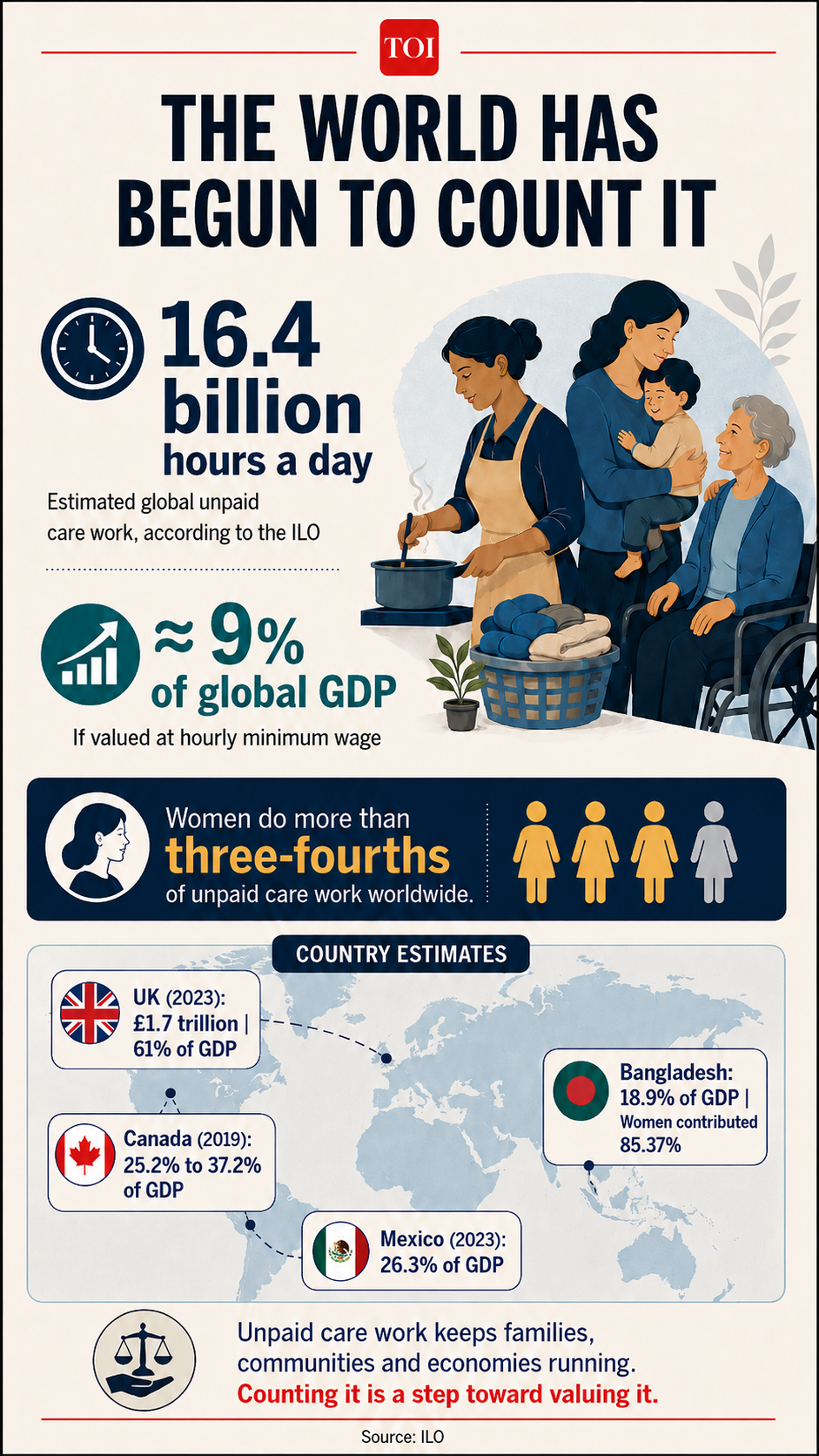
The International Labour Organization has estimated that unpaid care work globally amounts to 16.4 billion hours every day. If valued at hourly minimum wage, it would equal about 9% of global GDP. Women perform more than three-fourths of unpaid care work worldwide.Several countries already maintain household satellite accounts. The UK pegged unpaid household services at £1.7 trillion in 2023, equal to 61% of GDP. Canada calculated unpaid household work in 2019 at 25.2% to 37.2% of GDP. Mexico put unpaid domestic and caregiving work at 26.3% of GDP in 2023. Bangladesh estimated unpaid household and care work at 18.9% of GDP, with women contributing 85.37% of the total.
From recognition to policy
This is why the Supreme Court’s Rs 30,000 figure remains significant. It is a reminder that domestic care is not a sentimental abstraction. It is labour. It has time, value and economic consequences.The larger task is to move from recognition to policy. Time-use data should start meaningfully shaping labour policy, welfare design, urban planning and public finance.The most difficult change, however, must happen inside the home. Indian men have become more comfortable with women as colleagues, bosses, anchors, athletes and entrepreneurs. They are still less comfortable with women as people entitled to rest at home.In the Mahabharata, the mother was heavier than the earth. Modern India has repeated the sentiment often enough. The court has now put a clearer benchmark in that blank column. After generations of calling women’s efforts priceless, India has at least begun to admit that priceless cannot continue to mean free.







Leave a Reply