
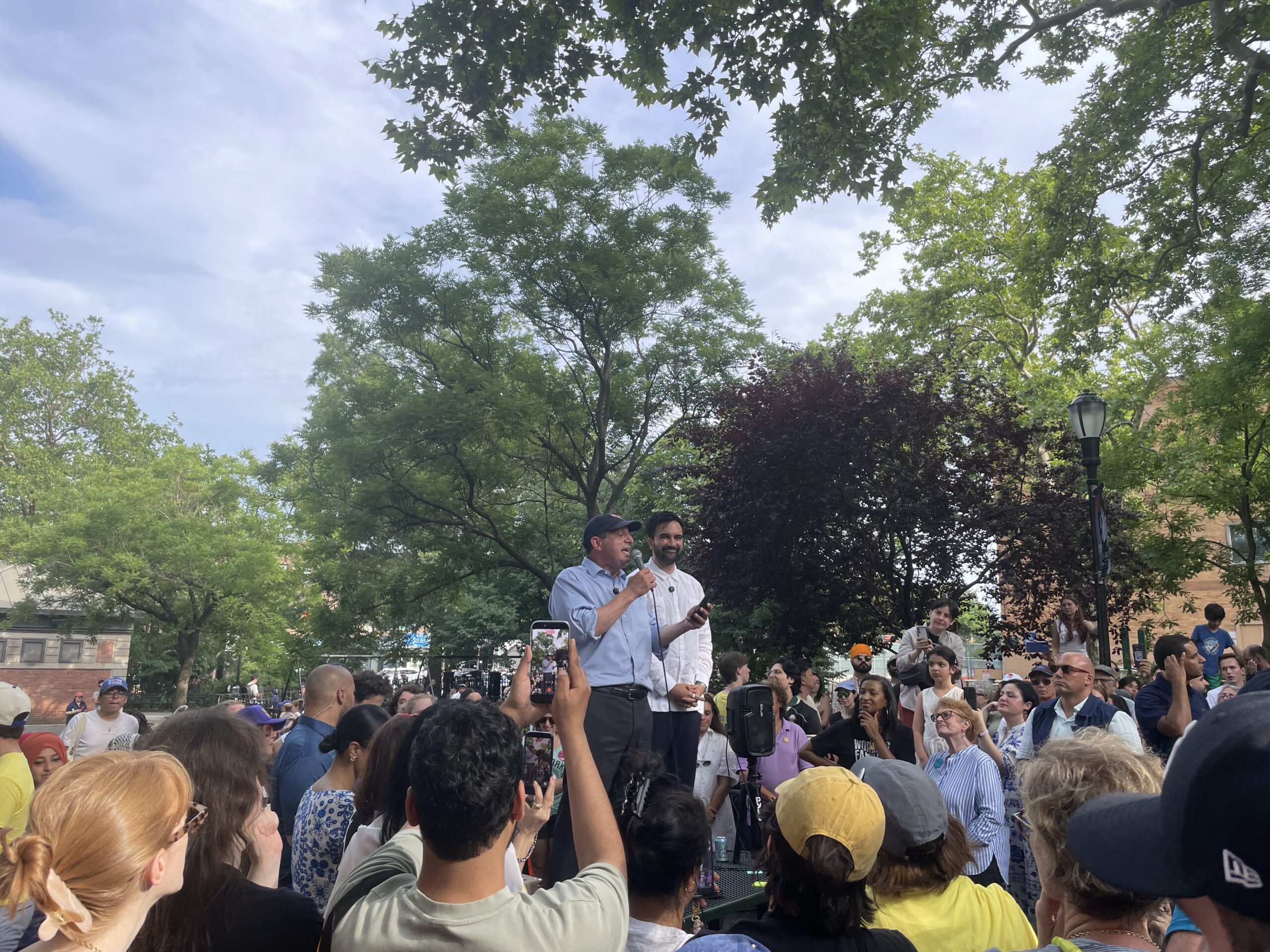
NEW YORK — The country’s most prominent pro-Israel special interest group isn’t even spending in Rep. Dan Goldman’s high-stakes primary. It could be his biggest problem anyway.
The American Israel Public Affairs Committee has a familiar electoral playbook: funnel millions of dollars into an election through a super PAC to boost pro-Israel candidates, attack those critical of Israel or both. The group’s massive spending over recent cycles has established it as a boogeyman among progressives, who’ve attempted to use AIPAC’s intervention, or the threat of it, to activate their base.
With days to go before New York’s primary, AIPAC hasn’t claimed involvement in any competitive races across the city. But it still looms large.
Across the country, attacks over AIPAC have hit a fever pitch this cycle on both sides of the aisle, speaking to the public’s increasingly negative view of Israel. In New York, insurgent challengers in Democratic primaries are using AIPAC as a cudgel to criticize opponents over their support for Israel. Some are suggesting shadowy super PACs are actually funded by the group and have pointed to donors who’ve previously given to AIPAC.
David Greenfield, a former New York City Council member and head of the Met Council, a Jewish charity, described that form of scrutiny as “a little obscene.”
“When we look back, this will have been the high point of anti-AIPAC fervor. I think some of it is irrational and unfair,” Greenfield said. “Crossing from anti-Israel to discriminating against Jewish constituents, I think that’s a very dangerous place to be.”
The tensions over AIPAC are especially prominent in Goldman’s race, where his challenger, former city Comptroller Brad Lander, has repeatedly hammered the incumbent over his ties to the group.
“We can’t let AIPAC and other pro-Netanyahu groups make an example out of me,” Lander wrote in a fundraising plea, one of more than two dozen that mention AIPAC. “Now when pro-Netanyahu groups are trying to control who gets elected to Congress, I’m asking you to join our movement to stop them.”
Lander — who, like Goldman, is Jewish — has positioned himself as more critical of Israel than the incumbent. He’s criticized Goldman for voting for U.S. military aid to Israel, called the country’s actions in Gaza a “genocide” and vowed to never take AIPAC money.
The message has persuaded many in the party’s progressive wing to side with him. The deep-blue 10th District, which covers parts of Brooklyn and Lower Manhattan, is where Mayor Zohran Mamdani, who endorsed Lander, had a dominant performance during last year’s mayoral primary.
At a “solidarity rally” for Jews and Muslims in Brooklyn on Sunday, Lander drew cheers from the hundreds gathered when he said he won’t take money from AIPAC. Mamdani appeared as a featured guest.
Goldman, who’s said the “legal terminology” of genocide should be avoided, has also criticized Israel. But no matter how much he tries to neutralize Lander’s attacks, they remain a prominent factor in the race.
The incumbent rolled out an ad denouncing President Donald Trump and Israeli Prime Minister Benjamin Netanyahu over the Iran war. He suggested he and Lander aren’t so different, saying last month: “We are both progressive Zionists who believe in Israel’s right to exist as a Jewish state, and we both support a two-state solution to bring peace to the region.” Goldman has also tried to shift focus away from Israel, arguing voters are more interested in kitchen table issues. And he’s even returned campaign donations he received from AIPAC, which endorsed him (though he still receives contributions from people who’ve donated through the organization).
When asked if AIPAC’s endorsement is harming him in the race, Goldman said: “It’s quite possible that it is.” But he took issue with Lander’s rhetoric around the group, which he’s called a “dog whistle.”
“It’s just continuing a pattern of lying to and deceiving voters with buzzwords and litmus tests that are not factual,” he said. “I am very concerned that people — Jews like Brad, who are using Israel and AIPAC as a wedge issue in a race — ultimately may win this battle, but do serious damage to the Jewish community.”

Speaking to POLITICO after Sunday’s event, Lander called that assertion “cynical.”
“I find that language offensive. Like, I don’t want the support of antisemites. I’m a proud Jew, I wear it on my sleeve,” he said. “What AIPAC is doing is a shanda, is bad for American democracy, is of course bad for Palestinians who are created b’tzelem Elohim, in God’s image, is bad for Israel, has shredded U.S. credibility in the world. And most people in this district, including, I believe most Jews in this district, agree with me.”
Lander acknowledged there’s no evidence of AIPAC super PACs getting involved in the race — either through its known entity or a newly created group, a strategy it’s employed in other races. But he pointed to AIPAC supporters donating to Goldman’s campaign and through a joint fundraising committee supporting Goldman along with Rep. Adriano Espaillat, who’s also facing a tough primary.
Lander said the “whole set of tropes around Jews and money” and rising antisemitism makes him “very anxious.” Still, he accused AIPAC of “corroding our democracy and making Jews less safe.”
During a debate Monday, the candidates were asked if they believe AIPAC is hurting the Democratic Party. Lander said it is — “by the way it spends money” and “demanding unconditional U.S. support for Netanyahu’s wars.”
Goldman said AIPAC “has some real problems and is harmful in many ways.”
“But they are an organization that I coordinate — or that I discuss things with — as is J Street, as are many, many other people, and I will always be independently focused on this issue,” Goldman continued.
Lander’s campaign quickly clipped that quote and shared it online. Goldman accused Lander of taking his words out of context “to mislead the public.”
The exchange underscores just how salient attacks over AIPAC are in Democratic primaries. But some are raising concerns.
In an interview with POLITICO last month, Pennsylvania Gov. Josh Shapiro, one of a handful of Jewish governors, said criticisms of AIPAC spending have “been used cynically by some to try and silence certain voices, to try and say that certain people participating in politics shouldn’t count or should be viewed in a toxic way.”
Halie Soifer, CEO of the Jewish Democratic Council of America, which is backing Goldman and Espaillat, said the rhetoric across Democratic primaries “has shifted into what I consider to be a dangerous place in this election cycle.”
“I’m concerned about the public demonization of perhaps what started as AIPAC, but now appears to have grown into rhetoric that includes the Israel lobby or Zionists,” Soifer said — noting that “can very quickly” blur into antisemitism.
While Lander has made criticizing Israel central to his campaign, Greenfield said he doesn’t think he’s crossed a line. But candidates in other races, Greenfield continued, are “seeing AIPAC ghosts wherever they turn.”
One race he thinks that’s happening is the contest to replace retiring Rep. Nydia Velázquez.
Assemblymember Claire Valdez, who has the backing of Mamdani and the city chapter of the Democratic Socialists of America, has sought to tie her most prominent opponent, Brooklyn Borough President Antonio Reynoso, to AIPAC. Both have called Israel’s actions in Gaza a “genocide,” though Valdez has frequently criticized Reynoso for taking so long to use the term.
She’s suggested that Real Fight NYC, a super PAC boosting Reynoso, is funded by AIPAC — despite there being no clear evidence of that. Real Fight NYC, which did not respond to a request for comment, will not have to disclose its donors until after the primary. But at least one donor to it has emerged: the American Federation of Teachers.

Valdez’s campaign pointed to AIPAC funneling money into shell PACs in other races, as well as a report that Reynoso supporters have also donated to AIPAC. But Reynoso has insisted he doesn’t take AIPAC money, and his campaign said it returned the money referenced in the story.
“These false accusations are an attempt to distract voters from the real issues,” said Jasmine Gripper, head of the state Working Families Party, which is backing Reynoso. “We should be focused on improving people’s lives, not spreading misinformation.”
Morris Katz, a top Mamdani strategist and Valdez adviser, wrote in a since-deleted X post that it’s “deeply dishonest” for progressives to “pretend that a new PAC just emerging now is anything other than an AIPAC shell.”
Patrick Dorton, a spokesperson for AIPAC’s main super PAC, United Democracy Project, has denied involvement in the race. As far as playing in other local primaries, Dorton said on Sunday that they’re “evaluating all of the New York races very carefully” but “don’t have anything to announce right now.”
Espaillat, like Goldman, is endorsed by AIPAC. In his run to retain his seat in upper Manhattan and the Bronx, progressive organizer Darializa Avila Chevalier has made criticizing the group a mainstay of her campaign, with her supporters suggesting some of the super PACs supporting Espaillat are funded by AIPAC.
The incumbent recently had his endorsement from the New York Progressive Action Network rescinded because it said he “has continued to accept money from AIPAC-related entities, has not signed the Block the Bombs Act, and recently declined to call the destruction of Gaza a genocide.” When asked if he broke a promise not to accept AIPAC money, Espaillat said he hasn’t “broken any promise in my political career.”
A recent poll commissioned by Justice Democrats, a pro-Avila Chevalier group, found 56 percent of likely Democratic voters in the district had a somewhat or very unfavorable view of AIPAC. Espaillat was asked in a debate Tuesday if he regrets accepting its support following the war in Gaza.
“No one dictates or tells me how to vote. My constituents do that,” he said, quickly pivoting to Avila Chevalier’s support from American Priorities, a super PAC seeking to counter pro-Israel entities.
That group is also supporting Lander and Valdez. Goldman and Reynoso have also criticized their opponents over American Priorities’ involvement.
But during their debate, Avila Chevalier once again turned the conversation back to AIPAC.
“I’d like to note that my opponent has yet to actually clearly and directly answer the question regarding his AIPAC money,” she said.




Leave a Reply