
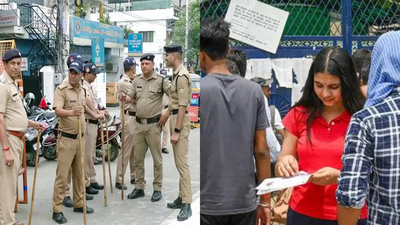
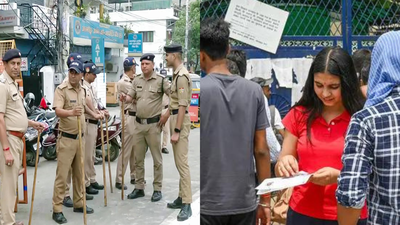
NEW DELHI: The national testing agency has made robust arrangements to ensure smooth conduct of NEET re-exam on June 21. Various measures such as pre-exam checks have been conducted across by authorities to ensure security.One of the main measure enforces the ban of Telegram app till the exam in conducted with govt claiming the app has been used to leak papers and thus, the ban will remain to ensure confidentiality and fairness.Additionally, in one of the most visible security measures, the government enlisted the Indian Air Force (IAF) to transport NEET-UG question papers. Since June 13, IAF transport aircraft and Mi-17 helicopters have carried out nearly 200 sorties to airlift sealed question paper packets to 18 designated distribution zones across the country, from where they are being moved to examination centres under tight security. Officials said the move was aimed at ensuring foolproof and time-bound delivery ahead of the June 21 re-exam.
NTA’s statement
NTA itself gave various assurances during the day. “On the eve of the NEET (UG) 2026 examination, the National Testing Agency (NTA) has put in place comprehensive arrangements to ensure a fair, secure and candidate-friendly examination,” it said.“The examination will be held in more than 95,000 examination rooms, each equipped with CCTV. A total of 13,560 CCTV cameras have been installed, with feeds monitored virtually at the National, State and Ministry levels. To secure the examination against electronic malpractice, 51,311 jammers have been deployed (17,054 by ECIL and 34,257 by BEL),” it added.Further detailing the security measures, it said, “Extensive personnel have been mobilised for examination-day duties. Each of the more than 95,000 examination rooms will have two invigilators, and every centre is staffed with more than ten additional examination functionaries. Candidate verification has been strengthened with 38,795 frisking staff and 48,448 personnel for biometric verification, with biometric manpower doubled and supported by face authentication so that verification is thorough while queues at centres are kept to a minimum.“The NTA said a Centre Systems Officer has been deployed at each of the 5,440 centres to monitor CCTV feeds and address technical issues. Around 6,700 observers and over 100 virtual observers will monitor the examination, with AI-based tools analysing live CCTV footage to flag anomalies. Authorities have also mobilised police, paramilitary personnel and other agencies, while a nationwide mock drill was conducted on June 20 to test all security systems, including CCTV cameras, jammers, frisking procedures and biometric verification.Additionally, a nationwide mock drill was conducted across the country on Saturday on the eve of the re-examin as part of efforts to ensure smooth, secure and transparent conduct of the medical entrance test, officials said.Earlier on Friday NTA said a comprehensive security framework has been implemented to ensure the integrity of the examination process. Confidential examination materials were transported under strict security protocols through GPS-enabled vehicles accompanied by police escorts. CCTV surveillance, Aadhaar-based biometric authentication and real-time monitoring systems have also been deployed at examination centres.
Key security measures
Here are some of the key security measures takenIAF conducts nearly 200 sortiesOne of the most significant measures introduced ahead of the NEET-UG re-examination is the deployment of the Indian Air Force (IAF) for the transportation of question papers. According to officials, IAF transport aircraft and Mi-17 helicopters have carried out nearly 200 sorties over the past several days to airlift sealed question paper packets to 18 designated distribution hubs across the country.The operation was launched to ensure secure and time-bound delivery of examination material following the controversy over alleged paper leaks in the original examination. From these hubs, the question papers are being transported to examination centres under police escort and strict security protocols. Officials said the use of military aircraft was aimed at guaranteeing a “foolproof” delivery system and minimising the risk of any disruption in the movement of confidential material.AI tools to monitor live CCTV feedsTechnology has emerged as a central pillar of the security architecture put in place for the examination. The National Testing Agency (NTA) has installed more than 13,500 CCTV cameras across examination centres, with feeds being monitored at national, state and ministry levels. Around 6,700 observers and over 100 virtual observers have also been deployed to oversee the examination process.For the first time, AI-powered tools will analyse live CCTV footage to identify suspicious activity and flag anomalies in real time. Authorities believe the additional layer of monitoring will help detect unusual patterns that may otherwise go unnoticed. Candidate verification has also been strengthened through biometric authentication, fingerprint scanning and facial recognition checks. In Tamil Nadu, for instance, candidates will undergo stringent biometric verification before entering examination halls.Police deployment scaled up across statesAlongside technological safeguards, authorities have mounted massive security operations. Police forces, intelligence agencies, cyber units, district administrations and, in some locations, paramilitary personnel have been mobilised to secure examination centres, question paper storage facilities and transportation routes.In Uttar Pradesh, where a large number of candidates are expected to appear for the examination, authorities have put in place a three-tier security arrangement. In Lucknow alone, the examination will be conducted across 75 centres. Joint Commissioner of Police (Law and Order) Babloo Kumar said, “The police deployment is structured into three tiers. The first team will be responsible for safely transporting the question papers to the centers and bringing back the answer sheets. The second team has been deployed to handle the checking and frisking of candidates and teachers using HHMDs. The third tier will manage law and order and security on the outer premises.”Similar arrangements have been made in other states. Ahmedabad Police have activated all six zonal DCPs and 15 police stations, while Rajasthan has deployed police personnel, Special Operations Group (SOG) teams and intelligence agencies to monitor centres and strong rooms round the clock. In Karnataka’s Haveri district, Central Paramilitary Forces have been deployed to strengthen security arrangements.Jammers, drone surveillance to curb malpracticeAuthorities have also introduced extensive anti-cheating measures aimed at preventing electronic malpractice and organised attempts to compromise the examination. Nationally, more than 51,000 jammers have been deployed to block unauthorised electronic communication during the test.In Ahmedabad, police will deploy drone surveillance and Quick Response Teams around examination centres. DCP Reema Munshi said, “The Crime Branch is deploying a Quick Response Team (QRT) and conducting drone surveillance. The Cyber Crime Branch will monitor social media to prevent any negative content from causing panic.”Several states have supplemented these efforts with local monitoring systems. Jharkhand has equipped all 67 examination centres with CCTV cameras and mobile signal jammers, while Rajasthan has activated technical surveillance systems and social media monitoring to identify attempts at malpractice. Kota authorities have also directed coaching institutes to report suspicious activity related to paper leaks or cyber fraud.Response Teams around examination centres, while the Cyber Crime Branch will monitor social media platforms for rumours, fake paper leak claims and content that could trigger panic among candidates. Jharkhand has equipped all 67 examination centres with CCTV cameras and mobile signal jammers, while Rajasthan has activated technical surveillance systems and social media monitoring to identify attempts at malpractice. Kota authorities have also directed coaching institutes to report suspicious activity related to paper leaks or cyber fraud.Security tightenedAuthorities in multiple states have established security perimeters around examination venues and strengthened monitoring of surrounding areas. The measures are aimed at preventing unauthorised access, crowding and any activity that could interfere with the conduct of the examination.In Ranchi, prohibitory orders under Section 163 of the BNSS will be enforced within a 200-metre radius of examination centres, restricting public gatherings and other activities during the examination period. Similar restrictions have been imposed in Dehradun, where police escorts will accompany question paper transportation and inspector-rank officers will supervise examination centres.Highlighting the scale of preparations in the state, Jharkhand’s Jamshedpur deputy commissioner Rajiv Ranjan said, “All preparations to conduct free and fair examination have been put in place. Proper security arrangements have been ensured, such as deploying CCTV cameras and mobile signal jammers.”Candidate welfare measures amid tight securityWhile security remains the primary focus, authorities have also announced several measures aimed at ensuring a smoother experience for candidates and their families, particularly in view of the summer heat.In Delhi, the government has established cooling zones equipped with seating, drinking water, ORS, shikanji and first-aid facilities at examination centres. Chief minister Rekha Gupta said the government was working to provide a comfortable and stress-free environment for students appearing for the re-examination amid prevailing heat conditions. Candidates will also be allowed free travel on DTC buses upon presentation of their admit cards.Elsewhere, authorities have focused on medical preparedness and basic facilities. In Karnataka’s Davanagere district, doctors will be stationed at examination centres, while officials have ensured adequate lighting, toilet facilities and dedicated safety rooms. Administrations across several states have also reviewed contingency plans for electricity, emergency response and crowd management to minimise disruptions on examination day.




Leave a Reply