
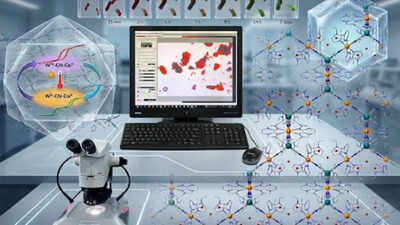
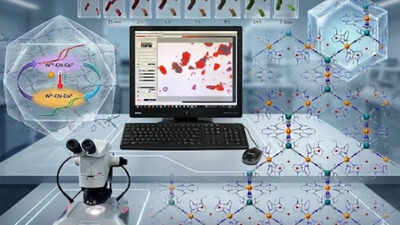
BENGALURU: IISc scientists have developed a new class of “smart” materials that can change their magnetic properties when exposed to light, heat or pressure, a breakthrough that could help build more sensitive industrial sensors, energy-efficient data storage devices and future quantum technologies.The findings, reported in two separate studies, describe porous crystalline materials that can repeatedly switch between magnetic and non-magnetic states without losing their performance. The researchers say the ability to reverse this change makes the materials suitable for repeated use in practical devices.The research, led by associate professor Abhishek Mondal of the Solid State and Structural Chemistry Unit (SSCU), tackles a long-standing challenge in materials science. Existing porous materials used in gas and liquid sensing often fail to switch their magnetic state uniformly because changes remain confined to a small part of the material.The team overcame this by designing a highly porous material with an elastic internal structure. When one atom changes its magnetic state, it triggers neighbouring atoms to do the same, creating a domino effect that spreads across the material.“In addition to mechanical pressure, light and heat can also stimulate the spin state switch reversibly, allowing the material to be used repeatedly,” researchers said.Mondal said they are already exploring practical applications. “We’re working on scaling up the complex to design smart gas-capture sensors that can selectively adsorb industrially critical gases like methane, carbon and carbon dioxide with supreme sensitivity,” he said.The second study addresses another major hurdle: temperature. Many existing materials with similar properties work only at extremely low temperatures, making them expensive and impractical outside laboratories.“Our goal was to synthesise a chemical system that exhibits these transitions near ambient temperatures. Contemporary materials often operate only at ultra-low temperatures below 50 K (-223°C). They are highly volatile and relax back to their ground state with even a slight rise in temperature,” Krishna Kaushik, a PhD student and first author of both studies, said.The new material functions close to room temperature and also changes colour as it switches between magnetic states, making the transformation visible to the naked eye.“…Although these discoveries are still at the fundamental research stage, they address important global challenges. Modern data centres and electronic devices consume enormous amounts of energy. Developing alternative materials that operate more efficiently could reduce energy demands and contribute to more sustainable technologies,” Mondal said.He added that materials capable of acting as sensors, switches and memory elements at the same time could simplify electronic devices and reduce manufacturing costs.







Leave a Reply