


NEW DELHI: India’s Overseas Citizenship of India (OCI) player policy, ignited after the All India Football Federation’s (AIFF) proposal during the Special General Meeting (SGM) on June 20, has stirred a debate over citizenship, sporting nationality and diaspora talent.TimesofIndia.com breaks down OCI rules, FIFA eligibility, AIFF’s proposed domestic league changes, the Government’s Sports Passport proposal and why OCI players can play for Indian clubs, but not yet represent India internationally. What is the difference between a PIO card, an OCI card and Indian citizenship?
- Indian citizenship is full legal nationality under the Citizenship Act 1955. It carries an Indian passport and the complete bundle of civil and political rights, including the right to vote, to hold public office, to public employment, and to represent India in international sport.
- OCI status, granted under Section 7A of the Citizenship Act 1955, is not citizenship and India does not permit dual nationality. It is best understood as a lifelong, multiple-entry visa with broad residence and work rights. An OCI cardholder enjoys general parity with Non-Resident Indians (NRIs) in economic, financial and educational matters, but the status confers no political rights and is expressly not nationality.
- The PIO card is now defunct. The PIO and OCI schemes were merged with effect from January 2015, cardholders were required to convert to OCI, and PIO cards have since been rendered invalid.
What rights does an OCI holder enjoy in India, and what rights are excluded?Rights enjoyed: A lifelong, multiple-entry, multipurpose visa; exemption from registration with the FRRO or FRO for any length of stay; the right to live and work in India without a separate employment visa; parity with NRIs in economic, financial and educational fields, including the ability to operate bank accounts, invest in Indian securities, purchase residential and commercial property, and access NRI education quotas.Rights excluded: No right to vote; no eligibility for public office or constitutional posts such as President, Vice-President, or a judgeship; no parity under Article 16 of the Constitution in matters of public employment; and no right to acquire agricultural land. Certain activities, including research, journalism, missionary work and mountaineering, require prior permission, and Protected or Restricted Area Permits apply as they would to any foreigner. Critically, the OCI Notification 2021 provides that in any field not expressly listed, an OCI cardholder is treated as a foreign national.
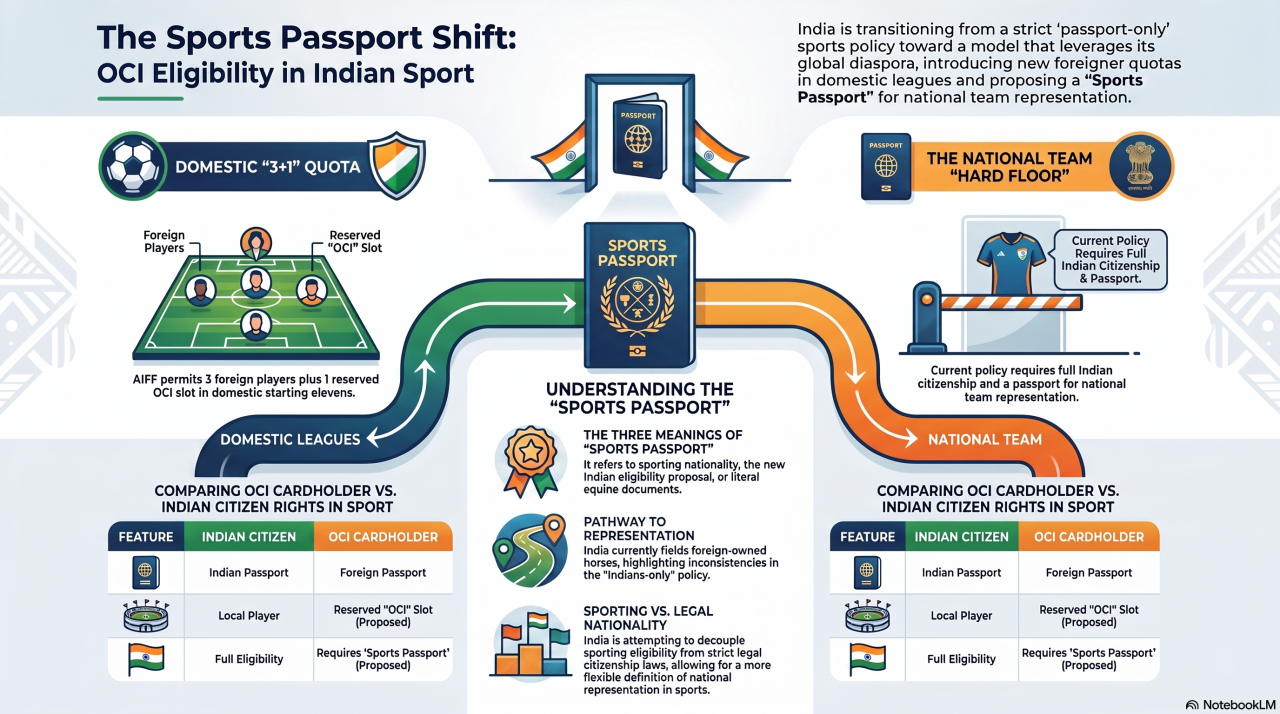
An illustration of current OCI rules and what the AIFF’s proposal could change. (TimesofIndia.com Graphic/NotebookLM)
Can an OCI holder represent India internationally in sport?So far, the rule is that an OCI cannot represent the country. National representation across Indian sport requires Indian citizenship and an Indian passport. This flows from the Ministry of Youth Affairs and Sports (MYAS) policy of 26 December 2008, reinforced on 12 March 2009, which restricts both government support and inclusion in national teams to Indian nationals, who alone may walk under the Indian flag. The Delhi High Court upheld that policy in Karm Kumar v Union of India (2010), where Justice S Muralidhar found the Indians-only requirement neither arbitrary nor unreasonable and noted the uniform view of the national federations that only Indian passport holders should represent India. Most international federations independently require the player to hold the nationality of the country concerned. The practical consequence is that an OCI cardholder who wishes to play for India must first renounce their foreign nationality and naturalise; in football, Ryan Williams surrendered his Australian passport in 2025. As did Arata Izumi in 2013, giving up his Japanese passport to play for India instead.That position is now under active reconsideration at the highest level, as the MYAS has signalled a shift. The MYAS has reportedly submitted a ‘Sports Passport’ proposal to the Prime Minister’s Office (PMO), seeking a special eligibility pathway that would allow qualifying OCIs to represent India, on some models without renouncing their foreign citizenship. The stated aim is to lift India’s competitiveness in football, basketball and tennis, and it is tied to India’s bid for the 2036 Olympic Games, drawing on naturalisation models used by Qatar, Bahrain, Turkey and Spain, among others.
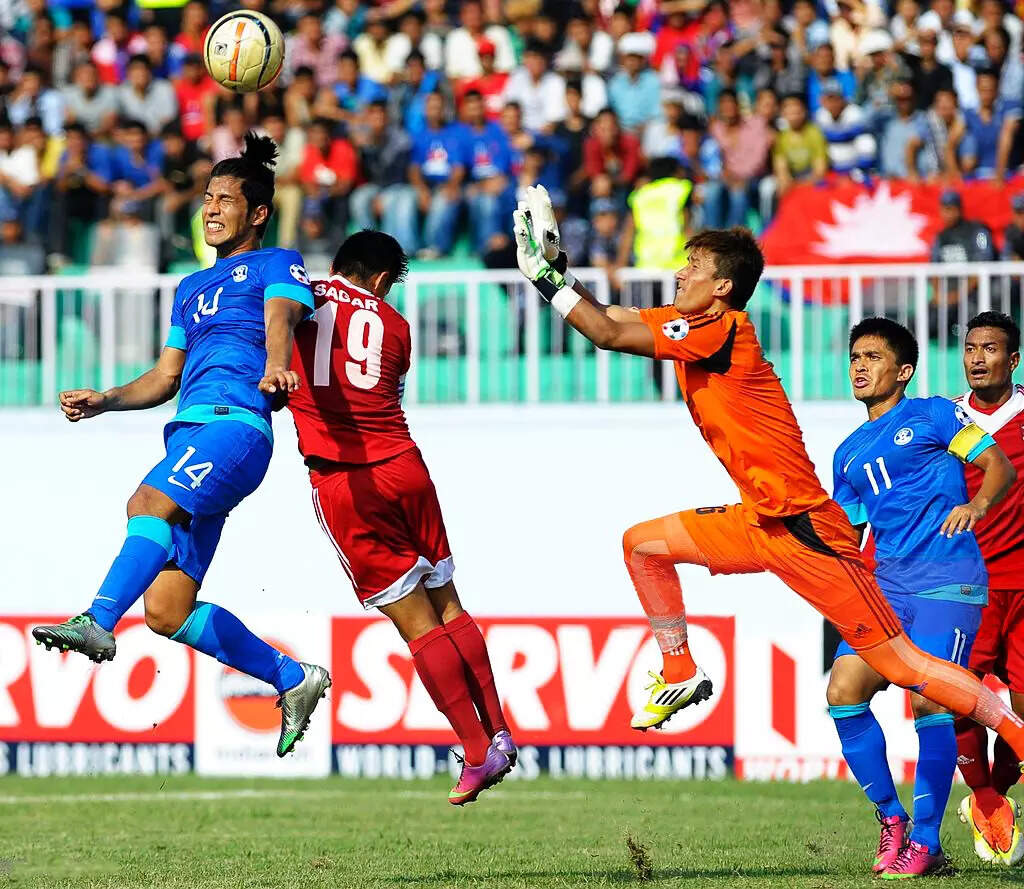
Japan-born Arata Izumi played 9 games for India between 2013 and 2014
That being said, equestrian sport provides a sharp relief to the existing policy, because it is the one discipline where the “athlete” can be a horse, and India already competes on foreign horses. For the Asian Games, India has fielded leased, European-owned horses; the horses leased ahead of Hangzhou 2022 were French-owned. That was permissible only because the Olympic Council of Asia and the organisers did not require the horse’s nationality to match the rider’s. The position is stricter for the Olympics. Ahead of Paris 2024 the FEI required the horse-owner and the athlete to share a nationality, which in effect rules out riding a horse leased from a foreign owner. A lease does not change a horse’s nationality, which under the FEI framework follows ownership, so recording a lease in the FEI Horse Passport does not make a French-owned horse Indian. The Equestrian Federation of India has argued before the Delhi High Court, in the Rajasthan Equestrian Association’s writ petition, that a horse is an “athlete” rather than “equipment” under the National Sports Development Code of India 2011 (2011 Code), while also maintaining that horses have no nationality, two positions that cannot both hold. The 2011 Code has now been superseded by the National Sports Governance Act 2025 (2025 Act), so it will be interesting to watch how this aspect is interpreted since the Act is silent on this aspect, however it leaves room for rules to be made on various subject matters. The irony however is hard to miss: India is debating how to bring in its diaspora humans even as it already fields foreign-owned horses, and the same Indians-only policy the ‘Sports Passport’ proposal would relax is being litigated in the equestrian context.
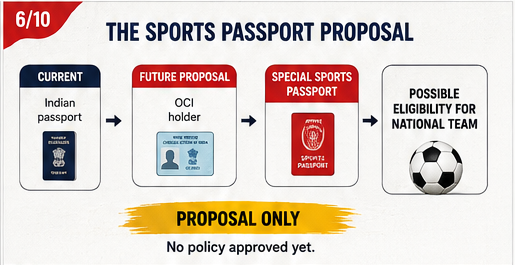
The Sports Passport proposal could be aimed at the Olympics, which India intends to host in 2036. (TimesofIndia.com Graphic)
What exactly is a “Sports Passport” in international sport?There is no formal, universal document of that name, and the phrase causes confusion. In the loose sense, people use the term “sports passport” to mean the documentary basis of a player’s sporting nationality, that is, the combination of a national passport, registration with a federation, and the eligibility paperwork an international federation requires, such as FIFA’s eligibility file or a change-of-association decision.In a separate and unrelated sense, the “Athlete Biological Passport” is an anti-doping tool i.e., an electronic record of an athlete’s biological markers over time, used to detect doping indirectly and has nothing to do with nationality.Equestrian sport is the exception that makes the metaphor concrete, because there the passport is literal. Every competing horse must hold an FEI Horse Passport, or an FEI-approved national passport with a Recognition Card. It is an official identification document recording the horse’s description and silhouette, its microchip, its ownership, its nationality and its vaccination and medication history, and it must be revalidated every four years. The horse’s passport, in this context, is not the loose “sports passport” of the human game, and it is not the Athlete Biological Passport either. And, notably, it does record a nationality, which is why the EFIs public claim that horses have no nationality is contestable on the face of it.In India the phrase has just acquired a concrete third meaning. The Government’s own proposal, submitted by the MYAS in June 2026, is branded a “Sports Passport” framework: a proposed special eligibility pathway for OCI athletes, modelled on systems used by Qatar, Bahrain, Turkey, Spain and others. So when an Indian now hears “sports passport”, it may mean any of three different things: the loose shorthand for sporting nationality; the proposed Indian eligibility mechanism; or, literally, the equine document.
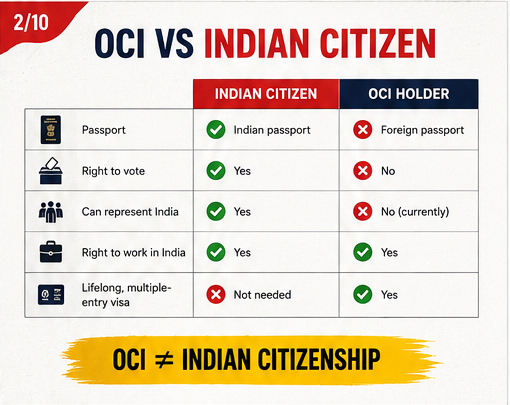
How the passport decides representation in sports events in India. (TimesofIndia.com Graphic)
Is sporting nationality different from legal nationality?Legal nationality is citizenship as determined by a country’s domestic law. Sporting nationality is eligibility to represent a particular federation under that federation’s own rules, which may rest on birth, parentage or residence, and which, once a player appears in an official match, generally ties the player to that federation. The Court of Arbitration for Sport (CAS) has held that “nation” and “country” in this setting are not to be read in their narrow political sense. The two concepts can therefore diverge: a player may hold one legal nationality yet acquire a sporting nationality elsewhere. India is unusual in collapsing the two, because by insisting on an Indian passport it makes legal nationality a precondition of sporting nationality.The Sports Passport proposal is, in effect, an attempt to prise the two apart, to grant sporting eligibility without requiring full legal nationality, which is exactly what the comparator countries do. If adopted, it would move India a measured step away from its current insistence that legal nationality must precede sporting nationality, and it is the clearest sign yet that the Government is willing to treat the two as separable. That the debate has been sharpened by players of Indian origin appearing at the 2026 FIFA World Cup for other nations only underlines the point that sporting nationality and legal nationality are not the same thing.The horse is the extreme case of that divergence, and it is instructive precisely because it shows where the flexibility stops. A horse’s sporting nationality is set by ownership and registration rather than by law: there is no birth rule, no residence test, and a horse’s nationality changes when its ownership changes. But it cannot be manufactured by a label. A lease does not confer nationality, the FEI Horse Passport records the nationality of the owner, and for the Olympic Games the FEI requires the owner to share the rider’s nationality. So even the most administratively flexible nationality in sport has a hard floor, which is ownership, not a registration of convenience. The human parallel is exact: a footballer does not become Indian by signing for an Indian club, and a French-owned horse does not become Indian by being leased to an Indian rider.
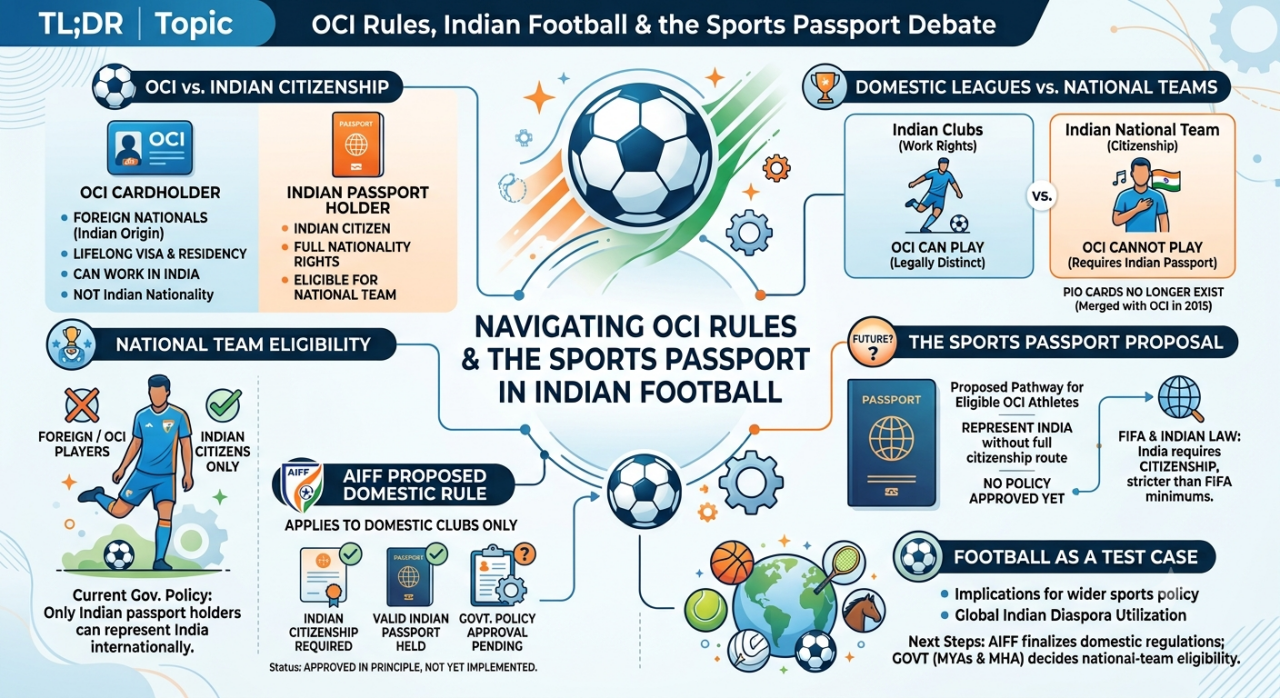
What are the OCI rules, AIFF’s proposal and Sports Passport debate in Indian football. (TimesofIndia.com Graphic/Gemini)
What documents determine a footballer’s eligibility for a national team?Eligibility is governed by Articles 5 to 9 of the Regulations Governing the Application of the FIFA Statutes (RGAS). A player must hold the permanent nationality of the relevant association (Article 5). A player assuming a new nationality must also show a genuine link, namely birth on the territory, a parent or grandparent born there, or continuous residence of at least five years after the age of 18 (Article 7). A player who has appeared in an official match for one association is, in principle, tied to it (Article 5(2)), and may switch only through the change-of-association procedure (Article 9), decided by the FIFA Players’ Status Chamber and recorded on FIFA’s Change of Association Platform. The supporting documents are therefore a valid passport evidencing nationality, birth certificates for the player and, where relied upon, the parent or grandparent, residence records where the five-year route is used, and the player’s match history. Appearances in friendly matches do not cap-tie a player, which is why Diego Costa could move from Brazil to Spain and why Ryan Williams remained switchable to India.Does AIFF have the legal authority to create a separate OCI category in domestic competitions?Broadly, yes. Squad composition and foreigner quotas in domestic leagues fall within a member association’s regulatory autonomy. FIFA leaves domestic foreigner limits largely to associations, confederations and national law, and the AFC (Asian Football Confederation) sets its own limits only for its continental competitions. AIFF is therefore within its powers to define an OCI classification and to reserve a starting-eleven slot for such a player in the Indian Super League (ISL) and the India Football League (IFL), which is what the 20 June 2026 SGM approved. The important caveat is that this is at present an approved decision rather than an enforced regulation. Clubs were not consulted, several are apprehensive about cost with the absence of a salary cap.
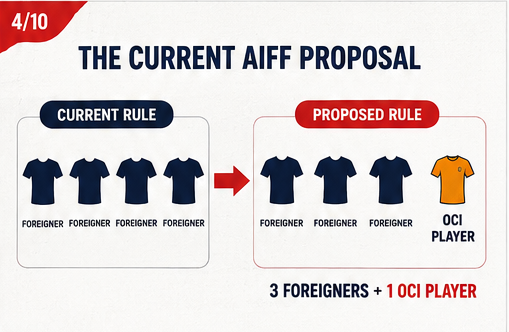
The AIFF has proposed that in the Indian Super League (ISL) and the Indian Football League (IFL), clubs may field a starting eleven comprising three foreign players and one OCI player. (TimesofIndia.com Graphic)
How does the proposed “3 foreigners + 1 OCI” rule fit within existing AIFF regulations?It modifies the existing foreigner-quota framework for the ISL and IFL. In place of an all-foreign overseas allocation, the rule permits three foreign players in the starting eleven and reserves the fourth overseas-type slot specifically for an OCI player. The SGM coupled this with a separate development measure requiring one Indian striker to remain on the pitch for the full 90 minutes. For this to operate, it must be codified into AIFF and ISL registration and competition regulations; the SGM decision is the policy, not yet the rulebook. For clubs in AFC competitions, the domestic classification must also coexist with AFC foreigner rules, which apply independently in continental play.Can AIFF classify an OCI player differently from FIFA’s nationality regulations?Yes, because the two operate on different planes and do not collide. FIFA’s nationality rules govern who may represent the national team, that is, sporting nationality. They do not dictate how a domestic league classifies players as “foreign” or “local” for squad-quota purposes, which is left to the association, the confederation and national law.AIFF treating an OCI cardholder as a distinct domestic category for ISL squad formation therefore does not conflict with FIFA’s eligibility framework, precisely because it is not a national-team question.What AIFF cannot do is use that reclassification to make an OCI eligible for the India national team; FIFA still requires the relevant nationality, and Indian law still requires the passport.
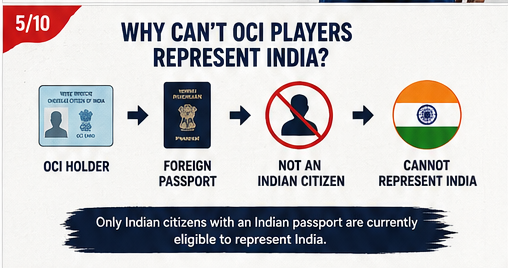
Currently, OCI players cannot play for the Indian national teams. (TimesofIndia.com Graphic)
Could the OCI quota face legal challenges from clubs or players?Yes, though the likely challenges would be private-law and regulatory rather than constitutional. As set out below (Answer 11), fielding an OCI player in a domestic league is in substance employment, for which OCI cardholders already hold work rights, so the citizenship question that governs national-team selection does not arise here. A challenge to the quota is therefore likely to be fought on the process followed by AIFF and the justification thereof, not on nationality. The plausible challengers are:
- The clubs, on grounds of process, the rule having been approved at the Special General Body Meeting of 20 June 2026 without their consultation, and of cost, given the wage inflation anticipated for OCI players in the absence of a salary cap.
- Domestic players or their representative bodies, arguing that a reserved overseas-origin slot displaces home-grown opportunity.
Are there any constitutional or citizenship-related hurdles to OCI participation in Indian leagues?For participation in a domestic league, the hurdle is low. Playing in the ISL or IFL is, in substance, employment, and an OCI cardholder already has the right to work in India on a basis of parity with NRIs, subject to the OCI Notification 2021. Fielding an OCI in a club competition is therefore lawful employment of a foreign national of Indian origin, and raises no citizenship bar. The citizenship and constitutional questions, including the prohibition on dual nationality and the Article 16 exclusion from public employment, bite only at the level of national-team representation, not at a private club contract. The hurdle is thus high for the national team and low for the league.
Fielding an OCI in a club competition is lawful employment of a foreign national of Indian origin, and raises no citizenship bar
Sports lawyer Aahna Mehrotra
Does the Ministry of Home Affairs or the Sports Ministry need to approve any OCI-related football regulations?For the domestic-league classification, Home Ministry approval is not required, because OCI work rights already exist and squad quotas are a matter of league regulation. For any extension to national-team eligibility, the position is different. The binding constraint is the MYAS’ policy of 2008 requiring Indian citizenship for national representation, and any relaxation would need the MYAS, with the Ministry of Home Affairs engaged on the underlying citizenship question. The Act 2025 adds a further layer: the National Sports Board now recognises national federations, and where a federation’s rules conflict with international statutes the Central Government may issue a clarificatory notification. A national-team OCI pathway is therefore a Government decision, not one AIFF can take alone; the domestic quota, by contrast, sits within AIFF’s own competence.Are there precedents from other Indian sports regarding OCI athletes?The precedent landscape is mixed, and the sharpest recent contrast is that cricket has moved in the opposite direction to the one AIFF now proposes. The Board of Control for Cricket in India (BCCI) resolved in December 2023, reaffirmed through 2024 to 2026, to require an Indian passport across all BCCI tournaments and age groups, expressly closing the earlier route that had allowed OCI cardholders to participate. So while football is proposing to open a domestic OCI slot, cricket has shut one. At national level the rule has been uniformly passport-only since the 2008 policy and Karm Kumar v Union of India (2010), across tennis, shooting, swimming and other disciplines that, in earlier and more permissive decades, had occasionally fielded expatriate or PIO athletes. Football itself supplies the naturalisation precedents of Arata Izumi and Ryan Williams. Equestrian, however, is the most instructive precedent of all, because it is where the Indians-only policy is actually being stress-tested in court. The EFI has for years fielded foreign horses, leased from European owners for the Asian Games, and now faces the Rajasthan Equestrian Association’s writ, in which the status of the horse, “equipment” under the 2011 Code or “athlete” as the EFI contends, determines whether fielding foreign horses breaches the directive that only Indian nationals may represent the country. Taken together, the pattern across Indian sport is threefold: cricket tightening, football proposing to open, and equestrian litigating the boundary.
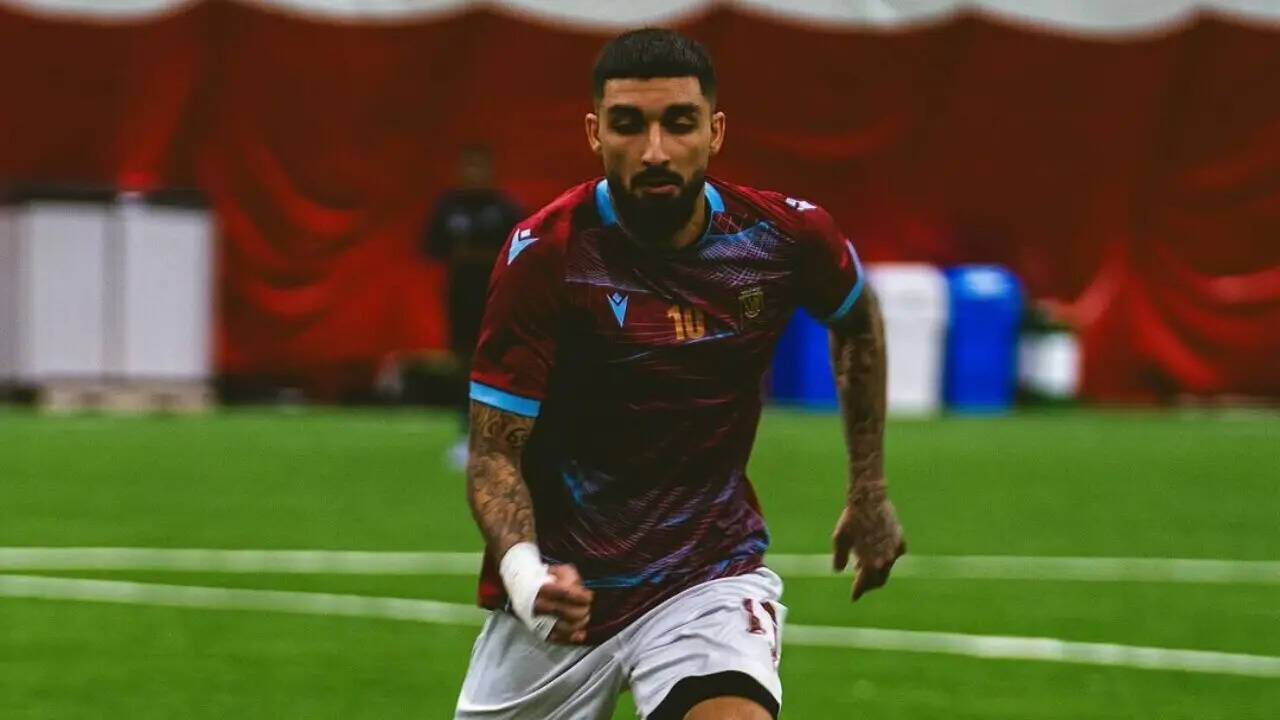
Canadian passport holder Shaan Hundal hopes to represent India one day – the country of his parents. (Instagram)
How do other countries treat diaspora players in domestic leagues?Most countries do not face the Indian problem at all, because they permit dual citizenship, so a heritage player is simply a citizen and counts as local. Where a structural category exists, the comparators are instructive.
- United States: In Major League Soccer (MLS), citizens, Green Card holders and certain special-status players count as domestic, with tradable international slots for the rest;
- Japan and South Korea: The J-League and K-League treat naturalised players as domestic and grant quota exemptions for AFC-partner and home-grown players;
- Philippines: The PBA operates an explicit “Filipino-foreigner” category for heritage players born abroad, capped in number, which is the closest structural analogue to a reserved OCI slot;
- Europe: Free movement under the Bosman Ruling, combined with home-grown player rules, governs squad composition.
The Indian peculiarity is that, because dual citizenship is barred, a diaspora player cannot simply be reclassified as a local, which is precisely why an OCI category has to be invented rather than assumed.What legal or policy changes would be required if India wanted OCI players to become eligible for the national team?The core blocker is that the Citizenship Act 1955 does not permit dual citizenship and OCI is not nationality. Amending the Act to allow dual citizenship is a heavy, security-sensitive step with consequences far beyond sport, and is widely regarded as a non-starter. The lighter options that have been canvassed are:
- Relaxing or amending the 2008 MYAS policy to recognise OCI status for representation in specified sports;
- A sport-specific notification or ordinance granting OCI cardholders eligibility for national selection, which would align Indian law with FIFA’s already-permissive diaspora rules;
- Discretionary fast-track naturalisation for elite athletes under Sections 5 and 6 of the Citizenship Act, which still requires renunciation of foreign nationality but can compress the usual residence requirements.
Every route engages the Ministry of Home Affairs on citizenship and the MYAS on policy. The constraint is purely domestic, since FIFA itself already accommodates diaspora eligibility.

Nepal-born Abneet Bharti first earned an India call-up last year and travelled to India this year ahead of fixture vs Hong Kong. (Instagram)
Q. Is this proposal primarily a football regulation, or could it become a test case for wider Indian sports policy?In the immediate term it is a football and ISL squad-composition regulation. But the premise that it might be narrow is already overtaken by events, because the OCI question has moved well beyond football. The MYAS’ Sports Passport proposal is expressly cross-sport, framed around football, basketball and tennis and tied to India’s bid for the 2036 Olympic Games. The policy question has therefore formally gone both cross-government and cross-discipline. Equestrian is already litigating the same Indians-only policy – whether fielding foreign athletes, in equine form, breaches the very directive that anchors the OCI debate in football. The AIFF rule is therefore best understood not as a self-contained league regulation but as one front in a wider, already-live contest over how India treats its diaspora and foreign-developed athletes. The Sports Passport proposal is the policy vehicle for that contest, equestrian is its current courtroom, and the football quota is its most visible flashpoint. If the domestic slot succeeds and pressure then builds for national-team eligibility, the football rule could become the template, very possibly under the framework of the 2025 Act. So it is both a narrow regulation now and a genuine test case for wider Indian sports policy, and the contrast with the BCCI’s opposite move only sharpens that.
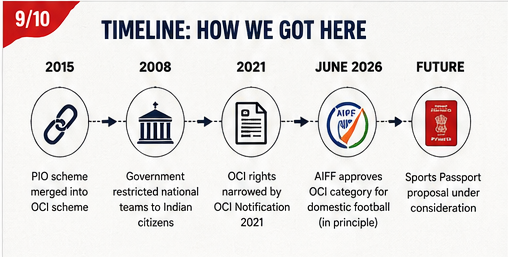
How the OCI, PIO and Sports Passport policies have changed over the years. (TimesofIndia.com Graphic)
Q. What are the next legal and administrative steps before the OCI rule can be fully implemented?For the domestic quota, the steps are:
- Converting the SGM decision into codified ISL and IFL registration and competition regulations;
- Consulting the clubs, particularly as the ISL moves towards a club-led operating model, and resolving the salary-cap and financial fair play concerns;
- Defining “OCI” precisely and settling verification, by reference to the OCI card and proof of origin;
- Aligning the rule with the revised AIFF Constitution under the 2025 Act and with AFC foreigner rules for continental competition;
- Fixing the season of effect, whether 2026-27 or 2027-28.
Any extension to national-team eligibility is a separate track that would require the MYAS and the Ministry of Home Affairs.NOTE:
- Persons of Indian Origin (PIO) scheme was merged into the Overseas Citizenship of India (OCI) scheme in January 2015, and PIO cards have since ceased to be valid.
- The OCI Notification 2021 narrowed the rights of OCI cardholders, treating them as foreigners in any field not expressly covered.
- FIFA carried out a wholesale modernisation of its eligibility rules in 2020. Finally, the All India Football Federation (AIFF) “3 foreigners plus 1 OCI” rule while approved at the AIFF Special General Body Meeting of 20 June 2026, is not yet codified.
(Responses by Aahna Mehrotra Founder, AM Sports Law & Management Co.)







Leave a Reply