
The United States turns 250 as the most powerful nation on earth. The story of its rise was written in treaties, dollars and aircraft carriers. The story of its perceived decline is being written in tariffs and the “quiet quitting” of old friends.
US@250: Primus inter pares
To paraphrase Abraham Lincoln at Gettysburg: Twelve score and ten years ago, the founders of an upstart republic brought forth a new nation conceived in Life, Liberty and the pursuit of Happiness. They could not have imagined that it would go on to remake the modern world in its own image. But for how long? That is the question.The United States is the most powerful country on earth. Its military is the most advanced anywhere, its defence spending far beyond any rival’s. Its forces can pluck a head of state out of his palace at the president’s pleasure; its jets can bomb any nation back to the “stone age”. The US economy is enormous: About $32 trillion at 2025 exchange rates, still comfortably bigger than China’s, with a per capita income many times higher. The dollar remains the anchor of global trade and finance.
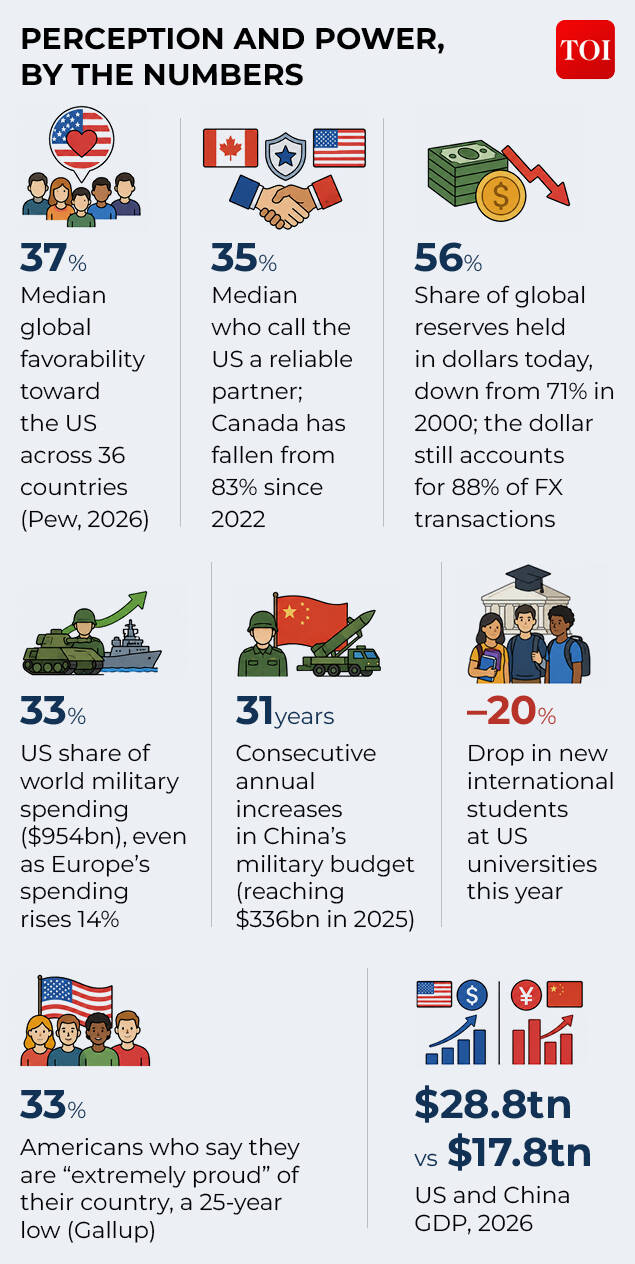
America at 250: The numbers behind its global standing
Then there is the Magnificent Seven: Alphabet, Amazon, Apple, Meta, Microsoft, Nvidia and Tesla. These are the most valuable technology companies in the world. In AI chips, Nvidia plays in a league of its own. The leading AI labs — OpenAI, Anthropic, Google’s Gemini — are all American. And there is Elon Musk, the world’s first trillionaire, who may yet plant human settlements on Mars.And yet American pre-eminence no longer feels inevitable. There is self-doubt inside the country, and questions outside it: Can America still lead? Does it even want to?Much of what troubles the world comes down to the whims of the current administration. Washington has thrown up tariff walls against allies and rivals alike, cast doubt on its own Nato commitments, courted strongmen and bullied its democratic friends. Allies who once worried in private are now making backup plans in the open.
The American dream: The ultimate soft power
For decades, the American dream did what American diplomacy could not. You didn’t have to love Uncle Sam to love Hollywood, jazz, jeans, the NBA, Apple or Google. America’s deepest power was its knack for making foreigners imagine themselves inside its story.For much of the world, and certainly for India, the US was never just another country. It was the place where an engineering degree could become a green card, and a small-town student a Silicon Valley founder. America did not merely attract foreign talent; it gave ambition a geography.Yale historian Odd Arne Westad, writing in Foreign Policy, called the United States “the first empire that is also a global nation”. Its appeal, he argued, rested on the idea that “anyone could become an American, whether through consumption, culture, or migration.”
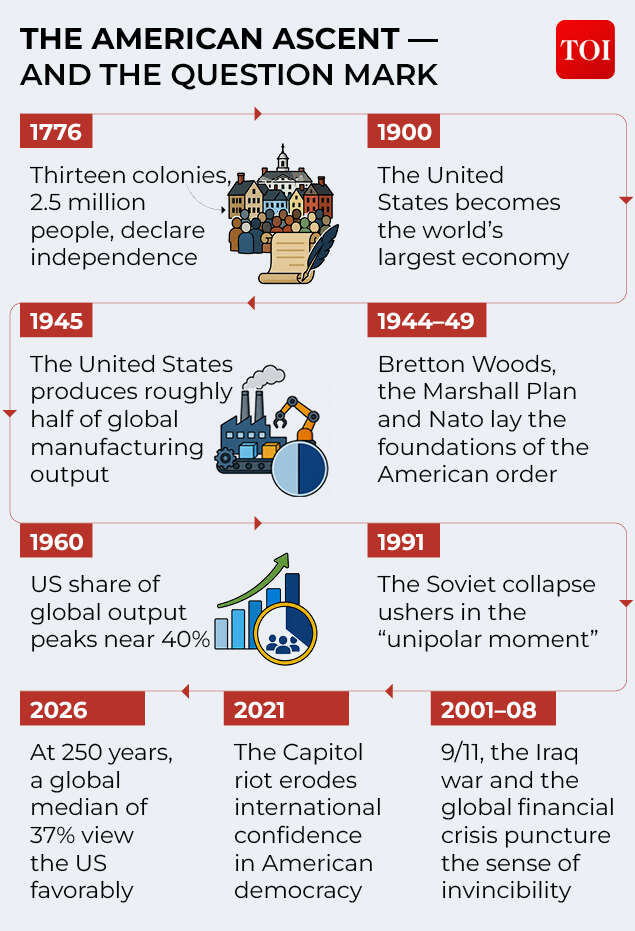
The milestones that shaped America’s global leadership
When the dream began to fray
None of this eroded overnight. Iraq damaged American credibility. The 2008 crash punctured the aura of financial mastery. The forever war in Afghanistan ended not in victory but with the Taliban back in Kabul. Mass shootings made American freedom look, from the outside, like a terrifying bargain. And January 6 showed that even the world’s most powerful democracy could be shaken from within.Donald Trump’s return has sharpened the unease. The Iran war has chipped away at US credibility further. The jury is still out on who, exactly, made an “unconditional surrender”: The US or Iran.
The dragon in America’s mirror
The US has China in its rearview mirror. But can Beijing do to America what Moscow never could? It is certainly the more serious competitor: Economically integrated, technologically ambitious, industrially massive, diplomatically busy. For every ChatGPT there is a DeepSeek; for a Tesla, a BYD; for an Instagram, TikTok; for a WhatsApp, WeChat.None of this means China is destined to replace America. It carries demographic stress, debt pressures, youth unemployment, a property hangover and an increasingly securitised political system. Its model attracts some governments; it does not inspire people. Few parents dream of sending their children to China for higher studies. Many still dream of American universities.But China has done enough to end America’s psychological monopoly. It has shown that capitalism can grow without democracy, that manufacturing muscle still matters, that infrastructure can be diplomacy — and that countries tired of Western lectures have somewhere else to turn. Even governments wary of Chinese dominance want Chinese leverage, if only to bargain harder with Washington.
For India, the romance is over but the relationship remains
The India-US relationship is one of the great strategic transformations of modern diplomacy. Through the Cold War, the two democracies stood apart: Non-aligned India was seen in Washington as too cosy with Moscow.Then came the long thaw: The civil nuclear deal, defence cooperation, the diaspora, the China factor, technology ties, and a bipartisan consensus in Washington that India mattered. Over two decades, suspicion turned into strategic comfort.The past year showed how fragile that comfort was. In the summer of 2025, the Trump administration went ballistic — inexplicably — over India’s purchases of Russian oil, slapping a 25 per cent penalty on top of an existing 25 per cent tariff. Indian exports suddenly faced a 50 per cent wall; no major economy was treated as harshly, and even China got better terms. Weeks later came a new rule demanding $100,000 for every fresh H-1B visa. Indians take about seven in ten of those visas. Whatever the wording, everyone knew whom the policy would hit hardest.
An ally of convenience, not conviction
The tariffs came wrapped in insults. President Donald Trump called India’s economy “dead”, turned on the warmth for Pakistan’s army chief Asim Munir, and claimed credit — repeatedly — for the May 2025 ceasefire that Delhi insists was worked out directly between the two countries. Commentators who had spent decades celebrating the “defining partnership of the twenty-first century” watched it crumble in a span of a few months.Here is the paradox: The relationship is strategically necessary and politically fragile at the same time. Defence cooperation moves forward while trade quarrels erupt. Technology ties deepen while visa anxieties grow. Leaders invoke shared values while domestic politics in both capitals rewards nationalist suspicion. The relationship is too important to walk away from — and no longer innocent enough to romanticise.For India, the lesson is plain. The US is not a benevolent elder of the democratic family; it is a great power with interests, domestic compulsions and a shortening attention span. India, for its part, is a rising power with choices, markets, talent and geopolitical weight. What happens next will depend less on sentimental talk of shared democracy and more on whether the two sides can manage asymmetry without humiliation.
Is America finished? Not so fast
America’s obituary has been written before, always prematurely. Political scientist Samuel Huntington counted several waves of American declinism before 1990 — after Sputnik, after Vietnam, after the oil shocks, at the height of the Japan panic — and each was followed by renewal.What is different this time is that the wound is self-inflicted, and the whole world can see it.At 250, the US is not a fallen empire. It is a superpower in a crisis of self-doubt and legitimacy: Unmatched in capacity, weakened in credibility, rich in alliances and surrounded by anxious allies.The world is learning to live with an America that is still mighty, but no longer sure it wants to lead the world it made.






Leave a Reply