


Somewhere on a server you’ll never see, your first Instagram post is still sitting there. So is that meme you saved at 2 am, the Spotify playlist you made for someone you don’t talk to anymore, and the Pinterest board of a wedding you haven’t planned. For a generation that has never known a version of itself that wasn’t documented, these aren’t throwaway digital clutter; they’re closer to a diary. Your phone probably knows you better than most of the people in your life.Here’s the strange part: when you die, the law mostly stops caring about you. Your rights end. But your data doesn’t. It stays exactly where it was, on a server in some data centre, encrypted, indexed, backed up, long after you’re not around to log in and check on it.So what actually happens to a digital life once the person living it is gone?It’s a bigger question than it sounds. Your digital footprint isn’t just the obvious stuff, the photos, the DMs, the tweets you’ve forgotten you sent. It’s every email, every voice note, every screenshot of a conversation you meant to delete. It’s the cryptocurrency wallet you set up once and forgot the password to. It’s your search history, your location data, your app usage, the quiet behavioural trail that platforms have been collecting in the background the whole time, whether you noticed or not.Put together, this is less a collection of files than a kind of second self, one built without much thought, and left behind without much of a plan. And increasingly, courts, tech companies, and lawmakers are being forced to answer a question none of them was prepared for: who does that second self belong to, once you’re not around to claim it?
When Apple said no, a Gujarat court said yes
A father dies without a will. His phone stays locked. And to get back into it, his family has to go to court.That’s what happened in Gandhinagar, where a civil court has ruled that a deceased person’s digital data, photographs, videos, documents, voice notes, form part of their estate and can be accessed by their legal heirs. The order came after Apple told the family it needed a court order before it would grant access to Shaishav Shah’s iPhone and iCloud account.Shah died in April 2025, intestate. His widow and daughter, Sur Shah, wanted into his locked iPhone and iCloud, not for anything financial, but for the photos, videos, voice notes, documents and contacts that were on it. Apple responded that it could reset the password on the iCloud account, but had no way to retrieve data off a physically locked device — and either way, it wanted a court order naming the family as the deceased’s legal representatives before it would act.

.
So the family, through advocate Jeet Bhatt, petitioned for a letter of administration under the Indian Succession Act. The widow filed a no-objection certificate in favour of her daughter. A public notice went out inviting objections. None came.The court’s reasoning is what makes this order significant. Additional senior civil judge Himanshu Choudhary held that the iCloud data “constitutes a valuable digital asset forming part of the estate of the deceased, capable of administration”, leaning on the broad definitions of “property” and “movable property” under laws like the General Clauses Act, 1897, the Bharatiya Nyaya Sanhita, 2023, and even the Income Tax Act’s recognition of Virtual Digital Assets. On privacy, the court was equally direct: the right to privacy is personal, and it does not survive death.
How big tech handles your death
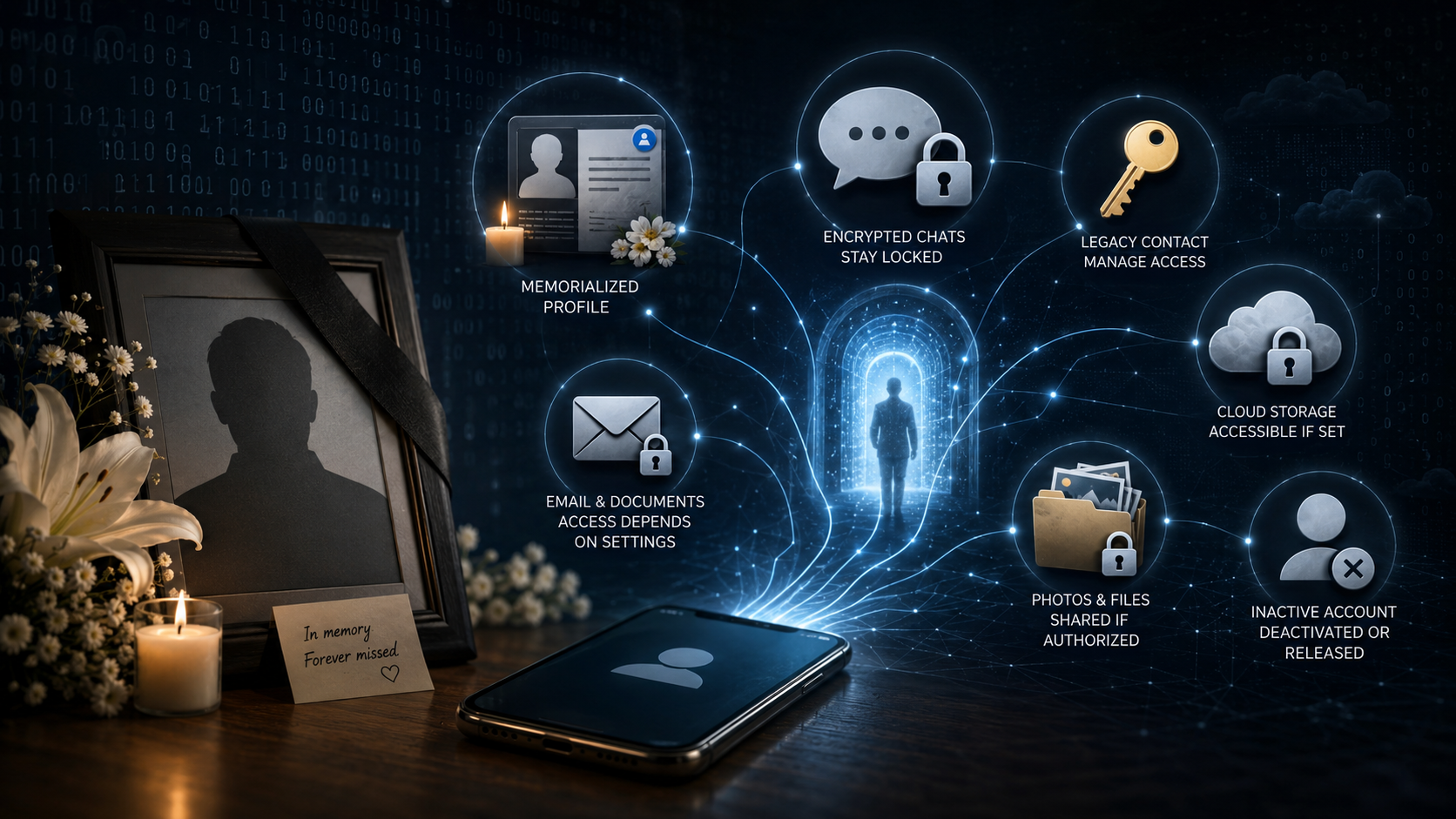
In the absence of any law telling them what to do, tech companies have quietly become the ones deciding what happens to a person’s digital life after death. There’s no court, no statute, no uniform standard, just each platform’s own internal policy, applied case by case.Here’s how the major ones handle it:Instagram memorialises the account of a person who has died; the profile stays up, but it’s frozen. No one can log into it, edit it, or see private messages. It becomes something closer to a tribute page than an active account.Facebook works similarly, but goes a step further with a “legacy contact”, someone the user names in advance who can manage the memorialised page, respond to friend requests, and pin a tribute post once the person is gone. What they can’t do is get into that person’s DMs. The messages stay locked, permanently.Apple lets users set up a legacy contact too, but only if it’s done ahead of time, while the account holder is still alive. Without that step, families are left going through Apple’s formal request process, and as the Gandhinagar case showed, that can mean a locked device, a locked iCloud account, and a request for a court order before Apple will act at all.
.
WhatsApp’s end-to-end encryption means there’s effectively no back door. Even with a death certificate, next of kin, and every intention of respecting the person’s wishes, family members cannot get into someone’s chats. The encryption that protected the user in life protects the conversation in death too, from everyone, including the people left behind.Google’s Inactive Account Manager is the outlier, the most proactive of the lot. It lets users pre-select trusted contacts and decide, in advance, exactly what those contacts can access: Gmail, photos, drive, once the account has gone dormant for a set period. Set it up, and your family isn’t left guessing. Skip it, and they’re back to filing a discretionary request with no guarantee of a response.X (formerly Twitter) takes a more hands-off approach: inactive accounts are deactivated after six months, and the handle can be released back into circulation. Family members can request deactivation, but they need to prove the death first.
Your data doesn’t know if it’s property or a secret
Not everything in a digital estate is the same kind of thing, and that’s where this gets complicated. A cryptocurrency wallet or a paid subscription is a digital asset, closer to property, the kind of thing succession law already knows how to handle. A string of private messages, or a search history, is something else entirely. It’s personal. And the law hasn’t caught up to the difference.Legal experts have flagged this exact gap, that “digital assets” and “personal information” aren’t necessarily the same thing, and while some digital property fits cleanly within existing succession law, deeply personal data raises separate questions of privacy and consent that don’t just go away because someone has died. Handing a daughter access to her father’s photos is one thing. Handing her access to every message he ever sent, to anyone, is another, and rulings like Gandhinagar’s don’t really draw that line yet.

.
There’s also a quieter, opposite problem building in the background: what if there’s nothing left to inherit at all? India’s draft Digital Personal Data Protection Rules, 2025 include a provision requiring platforms to delete a person’s data if their account sits inactive for a set period, unless they’re legally required to retain it. Like Apple’s Legacy Contact and Google’s Inactive Account Manager, DPDP Act, 2023 allows users to nominate someone in advance to exercise their rights over their personal data after death or incapacity.So India is edging toward two different futures at once. One, where a family can go to court and claim a full digital estate. The other, where an unclaimed account simply expires, and the data disappears with it, nominee or not. Not every digital life gets fought over. Some just get deleted.






Leave a Reply