
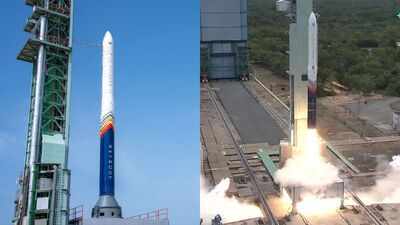
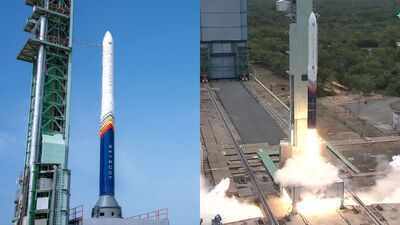
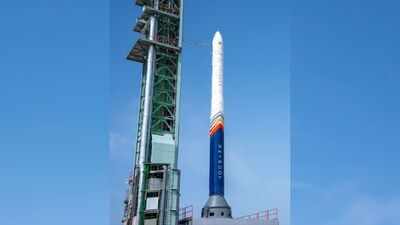
NEW DELHI: With the successful launch of India’s first privately designed and developed orbital-class launch vehicle Vikram-1 of Skyroot Aerospace on Saturday, the country’s first baby SpaceX is born.With maiden liftoff, Hyderabad-based space startup Skyroot, founded in 2018, has given wings to the Indian private space sector’s long-cherished dream to build a satellite launcher and become an alternative to Isro, which was till now the only space organisation in the country to have the capability to launch satellites from Indian soil.Of the nearly 400 space startups in India, only two startups, Skyroot Aerospace (Vikram-1) and Agnikul Cosmos (Agnibaan), till Friday had the capability to make and launch suborbital rockets, which could cross the Karman line (100-km altitude) but lacked the extreme horizontal speed (28,000 km/h) needed to stay in orbit. On Saturday, Skyroot’s Vikram-1 became the first orbital rocket developed by a private player that not only crossed the Kármán line but reached an altitude of 450km in the low earth orbit (LEO) and launched six payloads.LEO is very important for any country for strategic purposes and earth mapping requirements as this orbit houses military and defence surveillance satellites, earth observation and remote sensing satellites for high-resolution imagery (used in environmental monitoring, agricultural tracking and disaster mapping), and satellites for atmospheric and space science research.With more successful flight-tests, Vikram-1, a four-stage rocket, will soon cater to the rising demands of the Indian private sector to launch small satellites at LEO. With Isro’s hands full with so many other space programmes, including Chandrayaan, Gaganyaan and Bharatiya Antariksh Station, Skyroot’s rocket can also fulfil the satellite demands of the govt and military. Besides Isro’s PSLV, GSLV, LVM and SSLV rockets, Skyroot’s Vikram-1 will soon turn into a commercial launcher.The global commercial satellite launch service market size is currently estimated between $8.65 billion and $12.1 billion. Elon Musk-owned SpaceX holds a dominant position in this launch market, controlling 80%- 85% of global commercial launch capacity. In 2025 itself, SpaceX launched an estimated 3,500 to 3,800 satellites across over 160 successful orbital missions. India’s commercial space footprint is currently estimated at less than 2% of the global market share.Getting a big boost from Vikram-1 success, other space startups will now accelerate their orbital rocket programme and attempt to get a piece of the global market pie. With the Rs 27,000-crore Space-Based Surveillance-III program, Union govt also plans to deploy a 52-satellite military grid by 2029 — 31 of them to be built by domestic private companies.“I congratulate the entire Skyroot Aerospace team on the historic orbital launch of Vikram-1. Having spent years working within the satellite sector, witnessing this definitive moment is both inspiring and deeply moving. This milestone beautifully demonstrates how India’s space economy is thriving through a truly collaborative ecosystem where government, brilliant startups, academia, investors and global industry players are helping build the NewSpace future together. With the eyes of young India fixed on Sriharikota, the horizon for commercial innovation has never looked brighter.”Lt Gen AK Bhatt (retd), director general of Indian Space Association (ISpA) representing the Indian space industry, said: “The successful orbital launch of Skyroot Aerospace’s Vikram-1 is a defining milestone for India’s space journey. By executing the nation’s first fully private orbital flight, Skyroot has shattered legacy boundaries, demonstrating that our domestic industry is primed to handle end-to-end space missions. We are equally proud to congratulate the pioneering tech-demo payloads safely deployed on this flight, i.e. Cosmoserve Space’s EMBRACE robotic arm for orbital debris removal, Skyroot’s own SCOPE and Grahaa Space’s SOLARAS S3 satellite.”“The successful deployment of such complex, IP-heavy payloads prove that our private ecosystem is now building critical global infrastructure for space sustainability and high-resolution Earth intelligence. Beyond the engineering marvel of an all-carbon composite rocket, this launch is a masterclass in public-private co-existence. Furthermore, with Skyroot’s validation as India’s first spacetech unicorn, this success is a resounding signal to global sovereign and institutional funds,” Lt Gen Bhatt (retd) said.





Leave a Reply