
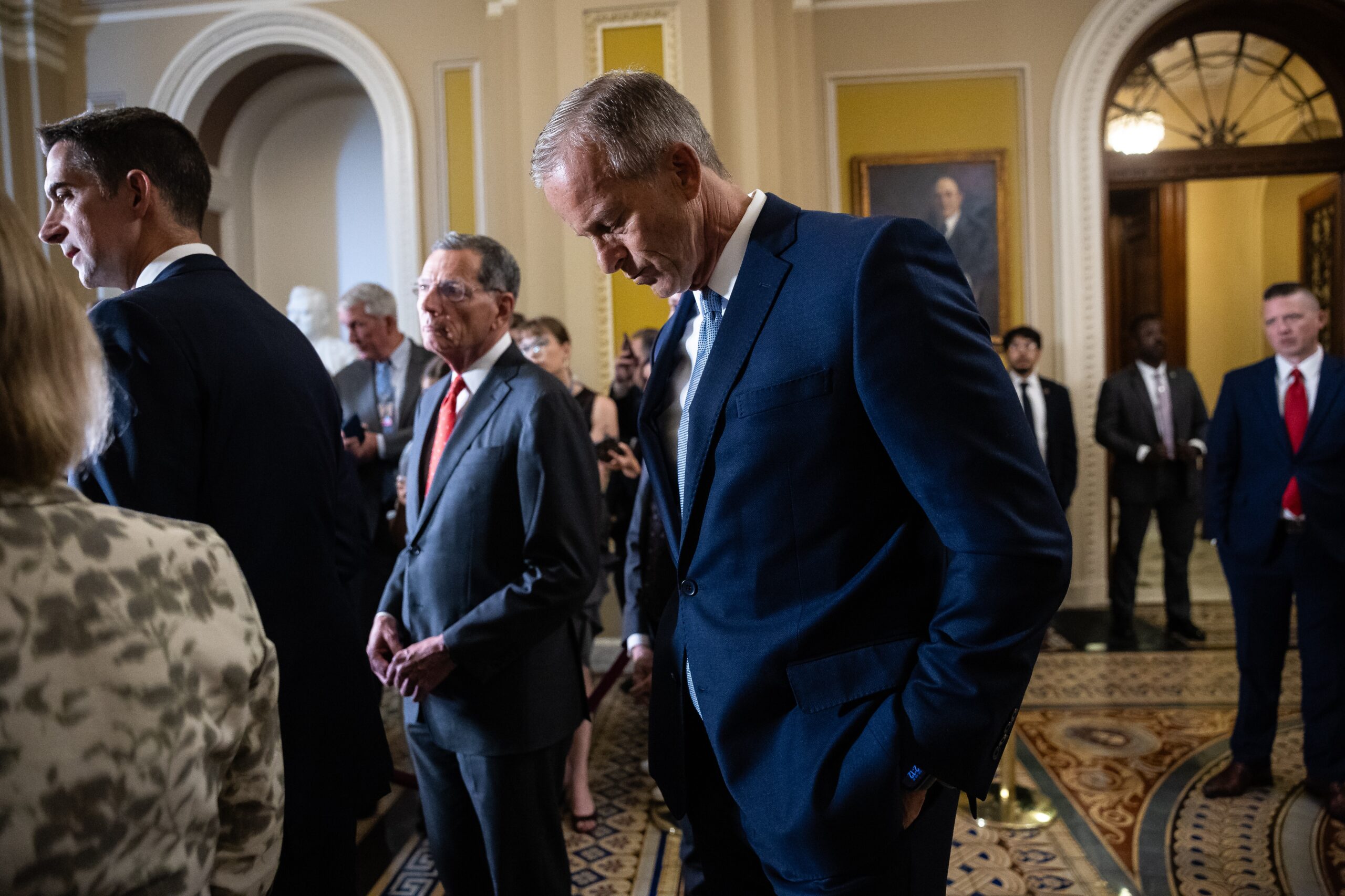

Speaker Mike Johnson successfully muscled Republicans’ Recon 3.0 ball into Senate Majority Leader John Thune’s court.
GOP Senators aren’t exactly thrilled to have it there.
“I don’t think Senator Thune’s going to take it up,” Sen. John Kennedy told reporters Wednesday.
GOP senators are likely to face a wave of pressure from the White House and House Republicans to move quickly and advance their budget resolution before August recess — the first step necessary to pass another party-line spending bill. But Thune has been frank about the rocky road the effort faces and careful not to guarantee he’ll be successful — before recess or ever.
Here are the obstacles he faces:
— GOVERNMENT FUNDING: GOP leaders are prioritizing funding the government past its Sept. 30 deadline before any party-line reconciliation bill.
“Our goal is to make sure we have government funded, and we want to get a continuing resolution done. … That’s number one,” Senate Majority Whip John Barrasso said in an interview.
Thune said this week he would hold the House’s budget resolution in reserve as an alternative way to fund the government if Democrats don’t cooperate on passing a stopgap.
But if government funding talks get punted to September, Republicans are also skeptical they’d advance the budget resolution given the close proximity to the midterms and the politically tricky votes that arise during the reconciliation process.
“I’m not a fan of pursuing reconciliation,” Appropriations Chair Susan Collins, who is up for reelection, said.
— DEFICIT HAWKS: Several Senate Republicans — including Rick Scott, Bill Cassidy and Rand Paul — are making it clear they will want to pay for part of the bill, as the House’s plan has no spending offsets.
Thune can only lose votes from two of his members and still secure the budget blueprint’s adoption, given unified opposition from Democrats. And Sen. Mitch McConnell is absent indefinitely for health reasons.
Asked Wednesday how close he was to having the 50 votes necessary to proceed on the Senate floor, Thune quipped: “Good question.”
And if Senate Republicans ask committees to look for ways to pay for the new spending, that could balloon the debate into a much larger fight about taxes, health care and other issues — and potentially force Republicans into politically sensitive votes.
“We literally have not had an organized conversation about reconciliation yet,” Sen. Ron Johnson, Republicans’ newly appointed Budget Committee chair, said when asked if 50 Senate Republicans were serious about wanting to do a third bill.
— SAVE AMERICA PUSHBACK: Senate Republicans don’t believe they’ll be able to get parts of Trump’s priority elections legislation into the bill amid pushback from some of their own members.
That’s assuming the provisions would adhere to the chamber’s strict rules for what can be included under the reconciliation process.
Sen. Thom Tillis warned last week that he’d “use every device I have available to slow down the wheels of government” if a reconciliation bill comes over from the House with components of the SAVE America Act included.
“Do the math,” he added.
What else we’re watching:
— HOUSE DEMS LOBBY GOP ON WAR POWERS VOTE: House Democrats are trying to convince more of their Republican counterparts to join them on an Iran war powers resolution they’ll force Thursday on the House floor. The House last month successfully advanced a similar measure to limit Trump’s military authority in Iran with the help of four Republicans. We’re now watching to see how many other Republicans may join them to back a resolution from Rep. Pramila Jayapal as strikes in the Middle East ramp up. Meanwhile in the Senate, Democrats will try to force their own Iran war powers resolution on the floor Thursday.
— AI-LAUNCHED CYBERATTACK SPURS BIPARTISAN BILL: Reps. Ted Lieu and Nathaniel Moran are introducing one of the most aggressive bipartisan AI safety proposals yet to emerge on Capitol Hill, POLITICO scooped. The bill comes days after OpenAI disclosed the first fully autonomous breach by two of its most advanced models. The bill would empower the Department of Homeland Security to order AI companies to slow, suspend or shut down advanced AI models deemed to pose serious risks.
Jordain Carney, Mia McCarthy, Riley Rogerson, Gabby Miller, Brendan Bordelon and Dana Nickel contributed to this report.







Leave a Reply