
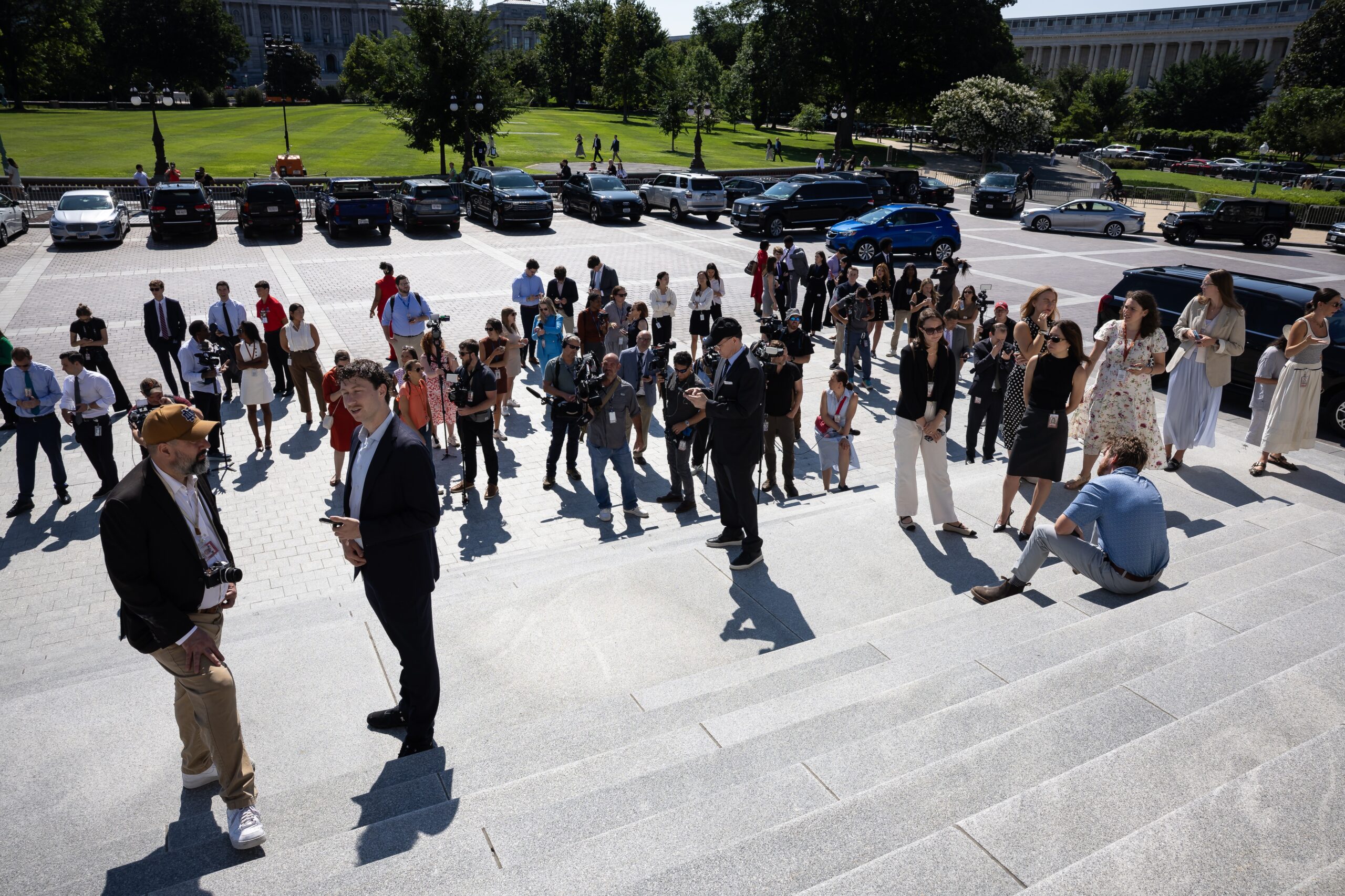

The Iran war’s increasing unpopularity, including inside the MAGA base, is weighing on House Republicans as they head back to their districts for a five-week recess to face voters ahead of the looming midterms.
They know they need to ease Americans’ worries about what many of them fear is beginning to look like an endless war yielding higher gas prices and other major affordability concerns.
“All of these issues will come up. I mean, Iran will absolutely come up,” Majority Leader Steve Scalise acknowledged Thursday. “Cost of living comes up. Safety and security, border security comes up. All of them come up, you know, and that’s why it’s important to remind people that we’re addressing those issues.”
It didn’t help that GOP lawmakers left Washington after four of their own broke ranks Thursday morning to help advance a Democrat-led war powers resolution rebuking President Donald Trump’s military operation in Iran.
The timing of the war powers vote right as members were leaving town — where among the four Republicans defecting was Rep. Tom Barrett, a vulnerable incumbent fighting to hold onto his competitive Michigan seat — had an unsettling effect among some House GOP lawmakers already spooked by poll numbers appearing to favor Democrats for a takeover in 2027.
“We have a hell of a lot of work to do, that’s clear,” one House Republican, granted anonymity to speak candidly, said as the chamber headed out this week.
Amid the political pressure around the war, National Republican Congressional Committee Chair Richard Hudson and other party leaders are trying to draw a contrast between the GOP and a Democratic Party facing down an rising insurgent left flank.
“We’ve passed some really good policies that are actually working. And so we’ve got a great story to tell to the voters,” the North Carolina Republican told reporters Thursday. “This election’s a choice between Donald Trump’s vision and Mamdani’s vision, and the voters are going to be with us.”
He was referencing Zohran Mamdani, the Democratic Socialist mayor of New York City who has become a GOP stand-in for the party following a string of progressive Democrats’ primary wins.
Some House Republicans tried to paint a rosy picture of their own achievements, having spent the past few days successfully pushing through major pieces of legislation that were seen as being in risk of failure at several points. Those anxieties were compounded by recent internal party meltdowns that forced Speaker Mike Johnson to lose control of the House floor for weeks.
Johnson’s wins this week include an annual defense policy bill, a measure to fund the government through Dec. 4 and a budget blueprint for a $95 billion party-line package. That package includes a massive cash infusion for the Iran war, plus farm aid and funding for the voter ID and citizenship components of the GOP election overhaul bill known as the SAVE America Act — Trump’s top legislative priority.
“If you would have told me on Sunday we could get all that done with low drama, I would have never believed you,” Rep. Mike Flood (R-Neb.) said in an interview. “We’ve got a plan going into the fall. We are committed to making sure the government continues to operate.”
But each of those House bills now head to the Senate, where they are expected to hit several hurdles — assuming any of them can move at all. Senators’ own version of the National Defense Authorization Act has stalled, while Senate appropriators are hoping to negotiate their own stopgap funding plan.
And Senate Majority Leader John Thune won’t commit to a timeline for moving the budget resolution, underscoring Thursday it does not have the votes at this point. It’s more likely than not that even if GOP leadership does decide to take up the fiscal blueprint, it won’t be before the Senate starts its own August recess, complicating the message for House Republicans during theirs.
Rep. Marlin Stutzman (R-Ind.) said he believed there was a “50/50” chance that Senate Republicans will adopt the budget resolution in the coming weeks, “and I’m not optimistic.”
House GOP leaders also keep pressing their members to highlight some of the benefits of Republicans’ “One, Big Beautiful Bill,” over the upcoming recess. But that message has largely fallen flat among Americans.
It has Democrats projecting confidence in their own midterm message and seizing on what they see as a series of political blunders by the GOP — including that the House Republican budget plan would greenlight billions in funding to cover the Trump administration’s exploits in Iran, which has driven up inflation.
“Donald Trump and Republicans have failed the American people, which is why they clearly are on the run and are on the verge of losing control of the House of Representatives,” House Minority Leader Hakeem Jeffries said Thursday.
Democrats are also feeling good about affordability and accountability-oriented legislative efforts they say are translating to promising polls and fundraising hauls. And while they have yet to fully outline how they would attempt to lower costs legislatively if they take the majority, Jeffries teased he will launch a new affordability “effort” on Sunday to mark 100 days until the midterm elections.
The party is also touting polling that shows mounting voter frustration with the Iran war — including among Republicans. A Wednesday Fox News poll shows voters saying Democrats can better handle income inequality by 22 percentage points, health care by 21 points, inflation by 10 points and immigration — Republicans’ top 2024 campaign issue — by one point.
On a generic ballot, Democrats are up by 11 points, according to an Emerson College poll.
“The cost of living goes up under Donald Trump and his war of choice,” the top Democrat on the Foreign Affairs Committee, Greg Meeks of New York, said in an interview. “And so that’s the messaging that we will continue to have to pour out to the American people, along with some of the crazy ethical problems that this administration has.”
Republicans have downplayed the polling so far. While Hudson acknowledged that midterm elections often benefit the party not in power in the White House, he believes this time around “that’s not the case,” pointing out that Republicans are trying to flip many House seats that Trump won.
“I’m polling in about 35 districts, and that’s going to decide the election,” Hudson said. “And in those polls, we’re leading in most, and we’re in the fight in the rest because we have better candidates. We actually have solutions to make people’s lives better, and thankfully we’ve got more resources, so we can tell that story.”
A handful of Democratic incumbents are also facing primary challenges that threaten to distract from the party’s salespitch of unity to contrast with their narrative about Republican disarray; Democrat-on-Democrat infighting is taking place in contests involving Reps. Debbie Wasserman Schultz in Florida, Ed Case in Hawaii, Shri Thanedar in Michigan and John Larson in Connecticut.
“I have to confess, I’m a little more worried about some of the folks that have primaries,” Rep. Don Beyer (D-Va.) said. “I just hate the idea of replacing people we know can win easily in November with people who could lose.”
Democrats aren’t taking anything for granted: “There’s only two ways to run: scared or unopposed,” Rep. Tom Suozzi, a vulnerable Democrat from New York, said in an interview. “You just got to keep on fighting.”
Calen Razor contributed to this report.






Leave a Reply