
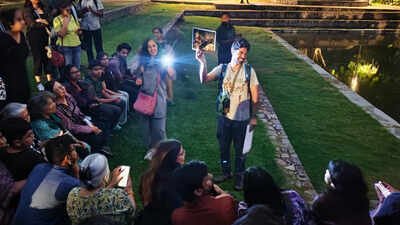
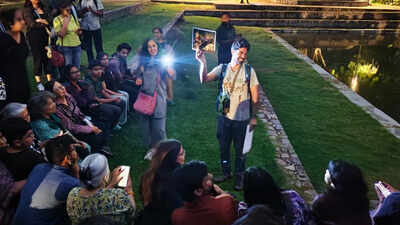
Nobody grows up wanting to be a bat person. Unless your parents fell in love over dead ones. For Aditya Srinivasulu, bats were never mysterious creatures of the night. They were family lore. Long before he became a bat biologist himself, the UK-trained researcher grew up with the now-famous story of how his parents — renowned zoologists at Osmania University, Chelmala and Bhargavi Srinivasulu — fell in love over dead bats. As college classmates, Bhargavi gifted Chelmala a dead bat instead of roses; years later, Chelmala returned the gesture with another dead bat on their wedding day. Fortunately, Aditya jokes, there is no pressure on him to replicate the romantic gesture. Today, when Aditya is not doing his academic heavy-lifting, he conducts evening bat walks across the sprawling green campus of Osmania University.The setting is a biodiverse, wooded stretch where evening descends over a shrinking summer lake and the sky begins to flicker with movement. “If you stand there and look up, the sky is littered with a swirling mass of bats,” Aditya says. “Think of a swarm of mosquitoes over your head near a lake — that kind of density. Except these are bats.” Most of the tiny, fluttering shapes overhead are pipistrelles, among the smallest bats in South Asia. Then there are the crowd favourites: the flying foxes. “Big leathery boys,” Aditya calls them affectionately. These large fruit bats emerge in dramatic numbers at dusk, soaring overhead while participants stand along the bund walkway. Sometimes they come within ten feet of the group. “As long as people don’t make sudden movements or do flash photography, there’s no issue,” he says. The myth-busting happens organically. Bats are not blind, not aggressive, not waiting to fly into human hair. Fruit bats actually possess excellent eyesight and an extraordinary sense of smell. Families, retirees, students and curious residents from across Hyderabad show up. “Honestly, the children are always the highlight,” Aditya says. The team hands out tiny stuffed bat plushies, and he watches reluctant children transform from “my parents dragged me here” to suddenly being completely fascinated. “Children ask the smartest questions. One child once asked if bats use sound to figure out where they’re going, how do they think so quickly?” Srinivasulu remembers pausing, momentarily stumped by the question. “Anything that goes bump in the night immediately gets associated with witchcraft, bad omens or danger. Animals like bats, owls and snakes are burdened by stigma and misinformation,” says the 28-year-old scion of the OG bat family of Hyderabad; he is now developing booklets and brochures on the city’s bat diversity aimed at everyone from four-year-olds to researchers.
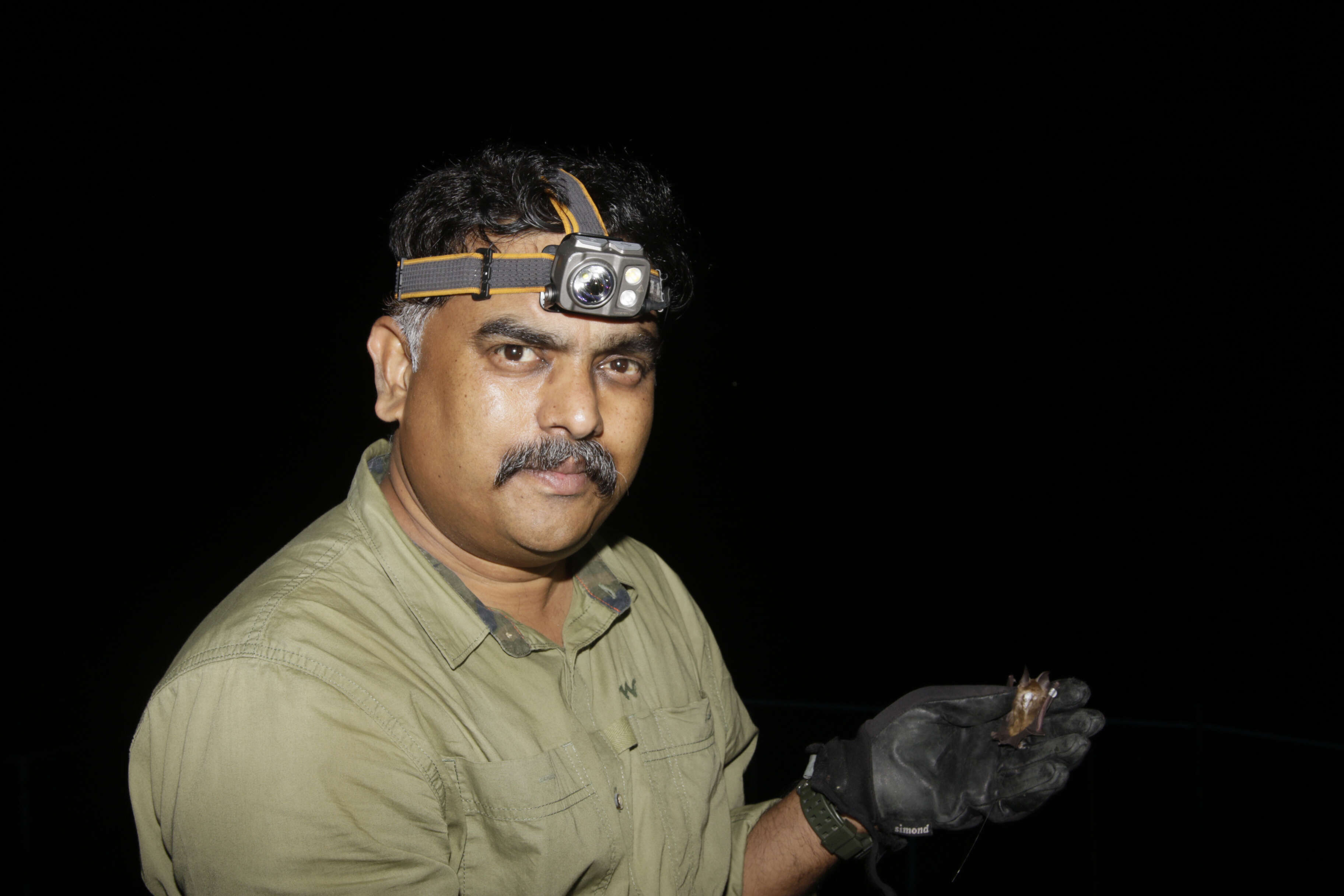
Rajesh Puttaswamaiah founded Bat Conservation India Trust in 2014
Aditya is not alone. Bat researchers across Indian cities are beginning to trade the lab coat for the headlamp, leading groups of curious oglers through darkening parks and ruins, passing around ultrasound detectors like prized telescopes to catch bat calls and translate them into a crackling chorus of clicks and static bursts. For most participants, it’s the first time they’ve not just seen a bat, but actually heard one “think” with echolocation. These researchers will tell you bats are the unacknowledged night-shift workers. When birds clock out at dusk, bats take over pollinating flowers, scattering seeds and hoovering up the kinds of insects that would otherwise devastate crops. Yet for a country that hosts around 135 bat species — roughly 10 percent of the world’s total — India has remarkably few people who actually study them. That imbalance is precisely why many researchers now say that getting the public on board matters as much as any fieldwork.“One of the biggest challenges is the lack of data or public participation when it comes to bats. Scientists alone cannot monitor every colony or every park. But ordinary citizens can,” says Nikhil John, a naturalist with WWF India’s Nature Connect outreach programme. That idea drove WWF India’s recent bat walks in Delhi, organised around International Bat Appreciation Day in April, which also marked the launch of a first-of-its-kind fold-out guide to the bats of Delhi-NCR. It documents 12 of the 15 species recorded in the region, complete with identification tips, habitats and where people might actually spot them across the city. The first walk at Sunder Nursery last month drew around 65 people. A second walk to Tughlaqabad Fort the next day merged natural history with architecture and storytelling.
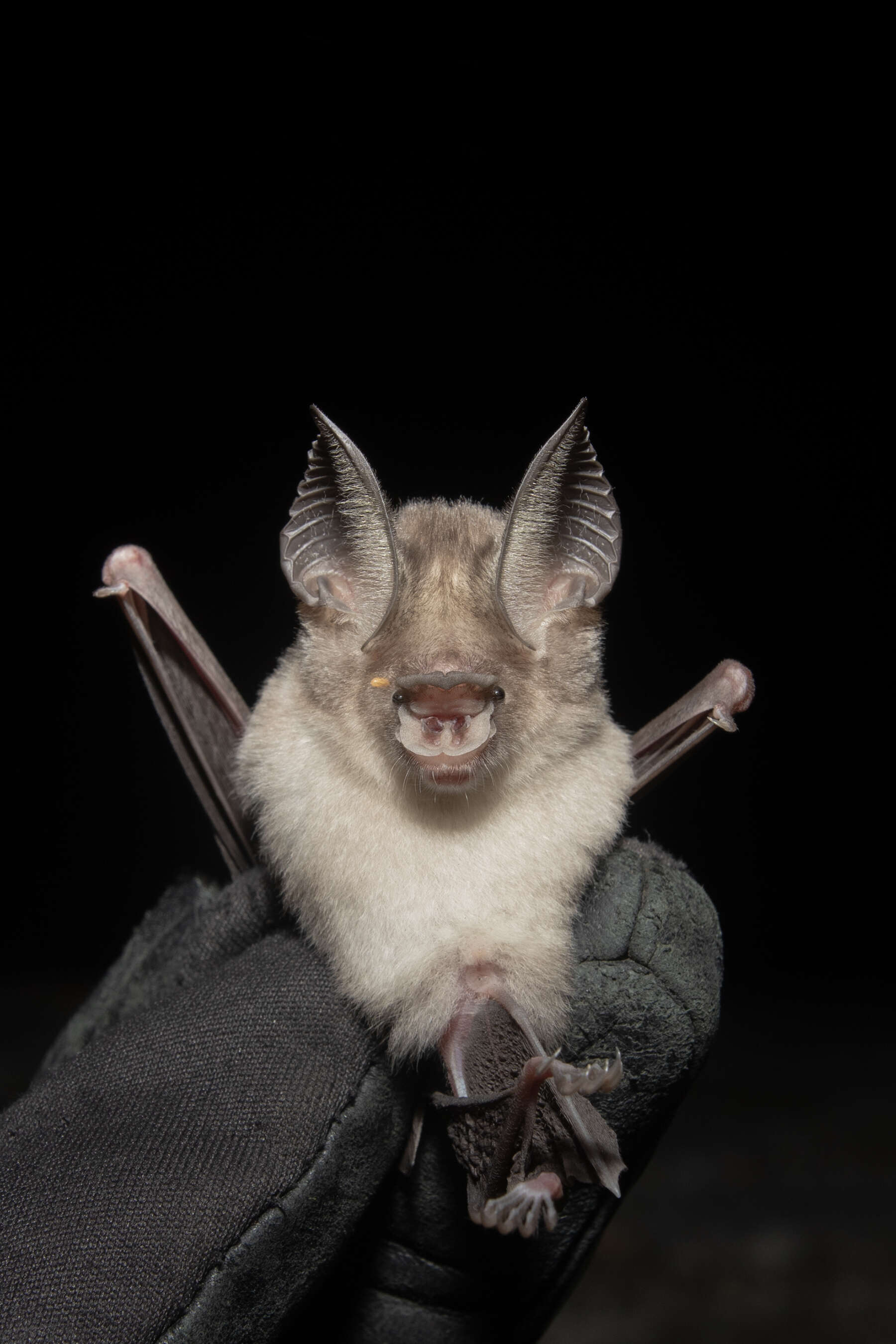
Kolar Leaf-Nosed Bat by Rajesh Puttaswamaiah
While birds have long dominated India’s citizen-science culture, bats have mostly remained invisible. There are birders everywhere. WhatsApp groups swap photographs from dawn trails, hobbyists upload sightings onto eBird, entire communities are built around identifying warblers and raptors. Bats instead are heard but not recorded, feared more than followed, thanks to haunted house and vampire movie mythologies. Conversationalists hope these walks become the springboard for a broader base of bat-watchers. John compares it to the rise of dragonfly festivals which transformed a largely ignored insect into a community-led conservation movement. “We now have volunteers and young people who are not from biodiversity or zoological backgrounds, but they can now talk about dragonflies and conduct walks.” The hope is to replicate that energy for bats. “This year we are also trying to do a three-day Bat Festival in Delhi,” John says.Beyond viruses and villainyBack in the pandemic era, when early evidence linked bats to the SARS-CoV-2 virus, they became global villains overnight. Alarming viral spillover theories prompted a wave of widespread—and often misguided—public fear, with calls for culling and roost destruction. And suddenly, bats needed a PR team. “With the unnecessary villainization of bats, we had to step up and be more vocal online in those days,” says Rohit Chakravarty, who has become one of the most visible public voices for bat conservation in India. The 34-year-old speaks at lit fests and schools, gives lectures in bars and cafés through Bengaluru’s ‘Pint of View series, and leads twilight bat walks through lakes, gardens and medieval ruins in Delhi and Bengaluru. He is also one of the editors of a hefty, 200-page ‘State of India’s Bats (2024–2025)’ report, the first-ever national assessment of bat species in India, compiled by 36 experts from 27 institutions, released by the Nature Conservation Foundation (NCF) and Bat Conservation International (BCI) in collaboration with WWF India . Although released last month, the report’s genesis really was the pandemic years, when researchers across India began collaborating on public statements against the killing of bats. “I think the Covid-era was a great turning point because we managed to convert the crisis into a more positive outcome,” says Chakravarty. One of the report’s central concerns is bats living in monuments. In Delhi, many protected monuments still shelter bat colonies because cities have lost most natural roosting spaces, yet bats are often treated as pests during restoration work. “This has been a cause of friction between the ASI and bat researchers for a long time. We’re trying to understand why bats are disliked in these spaces, how we can conserve them in monuments when there are no natural roosts left around cities, and how these spaces can become opportunities for public awareness,” he says. But he is careful not to romanticise bats as harmless mascots. “Any wild animal is dangerous. If you are in the same room with a tiger, the tiger will eat you. But if you are in the same room with a bat, the bat will not kill and eat you but the risk of disease is there from any wild animal.” During enclosed monument walks, participants wear masks and maintain distance from roosting colonies. “Let’s not single out bats. This applies to every animal.”Rajkumar Patel, another researcher who leads guided bat walks through Mumbai’s ancient rock-cut Buddhist caves at Mahakali in Jogeshwari and Kanheri inside Sanjay Gandhi National Park, gets particularly irritated about bat-blaming when it comes to zoonotic viruses from Covid to Nipah. “Bats carry pathogens but spillover happens when viruses jump species barriers through habitat destruction, wildlife trade, unsanitary conditions in wet markets and contamination like uncovered toddy sap collection sites. People should be more scared of mosquitoes and pigeons. They’re far more likely to transmit disease to you. How many times in your day do you actually come face-to-face with a bat?” Patel asks.His walks have participants hunting for clues in the dark: urine stains on cave ceilings, bat shit (guano) on stone floors, discarded insect wings and, if they’re lucky, spotting insectivorous species like Schneider’s leaf-nosed bat or the black-bearded tomb bat hanging upside down in the shadows. His favourite conversational detour is the false vampire bat, a carnivorous hunter that preys on amphibians, birds and even smaller bats. “False” only because the actual blood-drinkers live in the Americas. “But mosquitoes also suck blood. Leeches too. But as soon as we mention bats, people get really scared. That kind of partiality should be eliminated completely.” He also translates bats into a language everyone understands:F&B. “Mahua flowers, central to local liquor economies in central India, depend on fruit bats for pollination. Bananas, too. Tequila, one of the most trending drinks today, owes its existence to bats who are the primary natural pollinators of the blue agave plant. You won’t get chocolates too without bats. They act as natural pest controllers in cocoa plantations, eating insects that would otherwise damage cocoa pods.”When hobby became conservationNot all of India’s bat advocates came through the academic route. Some simply fell into it and never climbed back out. For Bengaluru-based Rajesh Puttaswamaiah, it started with a stack of forgotten film slides. A corporate lawyer and entrepreneur, he spent the 1990s as a birder and wildlife enthusiast before stumbling, while digitising old slides in 2011, upon bat photographs nobody around him could identify. “Wildlife conservationists back then would talk tiger, elephants, birds, leopards, but how come no one ever talked about bats? The existing public photos online didn’t help either. These images showed bats stretched out with their wings in awkward positions. Not really attractive. There are already so many negative myths about bats, and when you show them in an ugly manner, it doesn’t help.” So he decided to fix both problems. First through better photography, then by founding the Bat Conservation India Trust in 2014. Today his focus is the critically endangered Kolar leaf-nosed bat, rediscovered in 2013 near Hanumanahalli village in Karnataka’s Kolar district by a team led by Bhargavi Srinivasulu, one of the few female bat researchers in India. The bat exists nowhere else on earth. When Puttaswamaiah arrived in 2019, the mood was hostile: quarrying on the granite hillock housing the bats had just been stopped and locals were furious. “They used to come and shout at us, saying, ‘Because of you people, we lost our livelihood.’” Slowly, trust followed. “We tried to instil a sense of pride in them by saying that this is a rare bat found nowhere else in the world except their village,” he says. Hunting dropped, children stopped disturbing roosts, farmers cut back on pesticides and locals were persuaded to protect the tamarind and Pongamia trees the bats feed on. It has since grown into a 10-year management action plan with the forest department.
Share your thoughts in the comments
Be respectful · TOI community guidelines
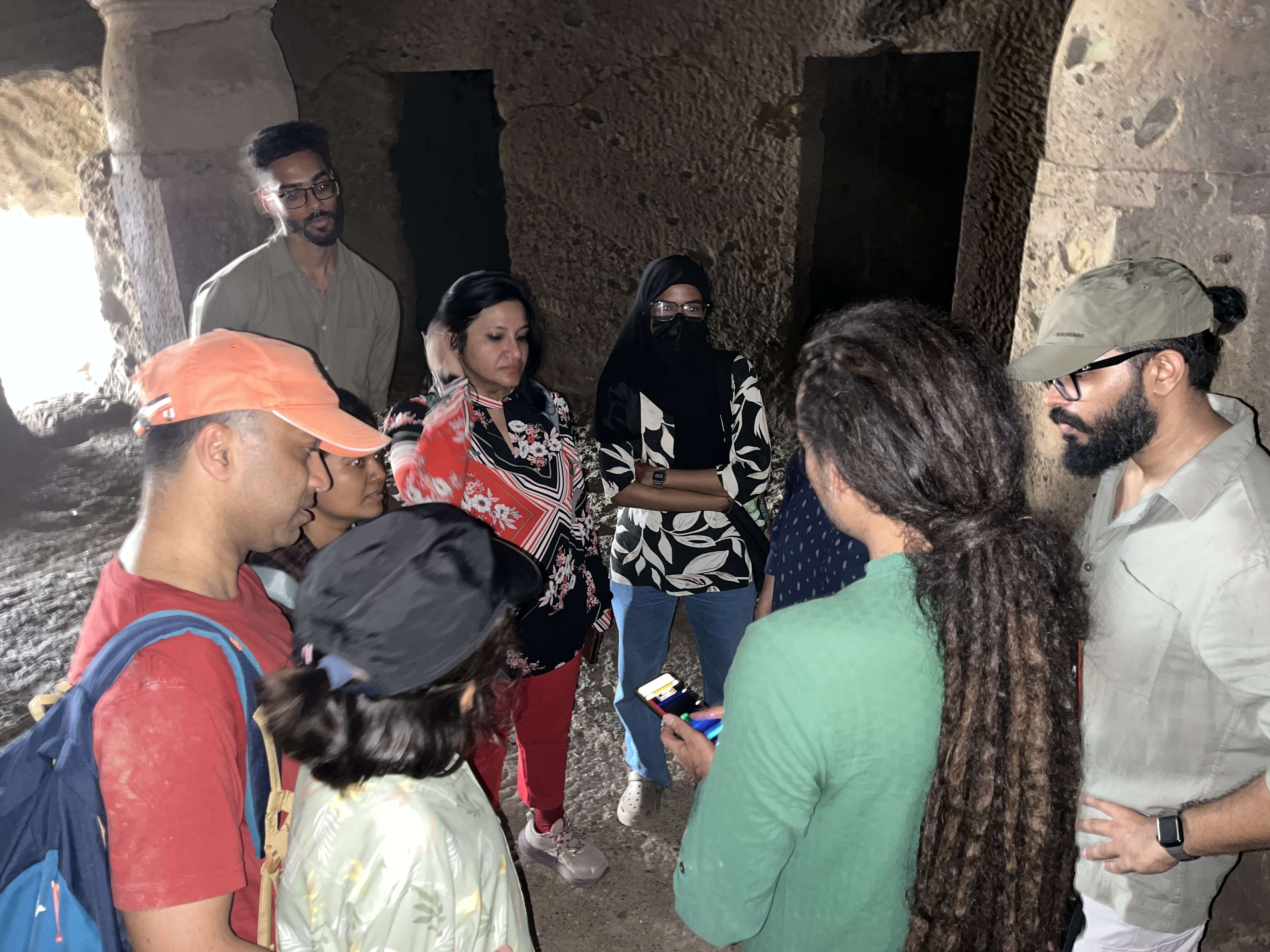
Rajkumar Patel, who leads guided walks through Mumbai’s rock-cut Buddhist caves, explains bat echolation using ultrasound detectors
But not every conservation story soars. An attempt to work with the Bomrr clan in Nagaland — who traditionally hunted bats — had to be abandoned after running into financial and cultural barriers. Members of the Bomrr clan in Nagaland traditionally hunt fulvous fruit bat colonies every year after the monsoon.”They sometimes smoke out entire caves, killing not just fulvous fruit bats but also other cave-dwelling species,” says Puttaswamaiah. He says his team spent two years and a lot of money trying to negotiate a compromise. “But they were not inclined toward that. For them, it is an annual ritual, and their belief was that unless they hunted and ate these bats, their ancestors would not accept them. So ultimately, the project had to be shelved,” he says. “Without involving local communities, we can’t do any conservation,” says Puttaswamaiah. Bat conservation, he has learned, is as much about navigating culture, livelihoods and identity as it is about science.







Leave a Reply