


Nasa just invited India to help build a permanent base on the Moon. It’s the kind of headline that writes itself — and yet, what it actually means for India is still almost entirely undecided.Nasa wants to do something considerably more ambitious than return astronauts to the Moon. It wants to start building a place where humans can eventually stay. The agency’s new Moon Base programme envisages a sustained human presence near the lunar South Pole, built gradually through robotic missions, crewed landings, commercial landers, rovers, power systems, communications infrastructure and, eventually, habitats.
From visiting to staying
The Moon Base is essentially a shift in emphasis from exploration missions to infrastructure. The first phase, through roughly 2028-29, is expected to focus on learning how to operate reliably at the South Pole. Robotic landers and rovers will map terrain, study the extreme environment and test technologies for power, communications, mobility and navigation.
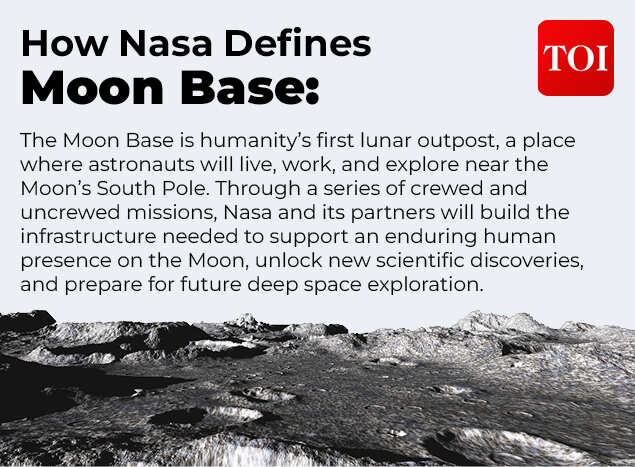
The second phase, roughly from 2029 to 2032, is intended to introduce early infrastructure, including pressurised modules and more capable power and life-support systems. Japan, for instance, is expected to contribute a pressurised rover that could allow two astronauts to travel and work away from the main landing site for extended periods.The longer-term vision involves larger habitats, regular cargo deliveries, more powerful energy systems and experiments aimed at using materials found on the Moon itself. That last part is particularly important.
Why the South Pole?
The lunar South Pole offers two things future explorers badly need: water and sunlight. Some craters there remain permanently shadowed, allowing water ice and other volatile substances to survive for billions of years. If that ice can be located and extracted economically, it could potentially provide water for astronauts and, after processing, hydrogen and oxygen for life support and perhaps rocket propellant.At the same time, some elevated areas receive sunlight for much longer periods than most of the lunar surface, making them attractive locations for solar power.But the South Pole is also exceptionally difficult terrain. Deep shadows, steep slopes, boulders and extreme temperature differences make landing and driving difficult. Lunar dust is another problem, potentially damaging seals, machinery, optics and solar panels.The proposed base therefore depends on technologies that are still being developed: autonomous navigation, dust-resistant systems, long-duration power, thermal protection and eventually the ability to extract useful resources from lunar material.
Where does India come in?
This is where it is tempting to get ahead of the facts. India clearly has capabilities that could be relevant. Chandrayaan-1 discovered water molecules. Chandrayaan-3 demonstrated a soft landing in the lunar South Pole region, while India’s lunar programme has built expertise in studying the surface and environment.That could make Indian instruments, experiments, rovers or scientific expertise useful to a future international lunar effort. India could potentially contribute to surface science, resource mapping, robotics, communications or data analysis. But potentially is the operative word.There is currently no basis for saying that India will supply a particular rover, build part of the habitat, provide a power system or receive a defined share of the scientific output. Those are matters that would have to emerge from negotiations and programme planning.The invitation nevertheless matters because it puts India in a position to discuss those possibilities at an early stage. India is not approaching the Moon Base as a newcomer. Its recent lunar missions give it experience that could be relevant to the programme, particularly at the South Pole. But an invitation doesn’t automatically translate into a major role.
Why build a base at all?
For Nasa, the Moon is also a test bed for Mars. A sustained lunar presence would allow engineers and astronauts to learn how to keep people alive and equipment working away from Earth for long periods. It would provide experience with radiation, lunar dust, closed-loop life support, surface mobility and using local resources.
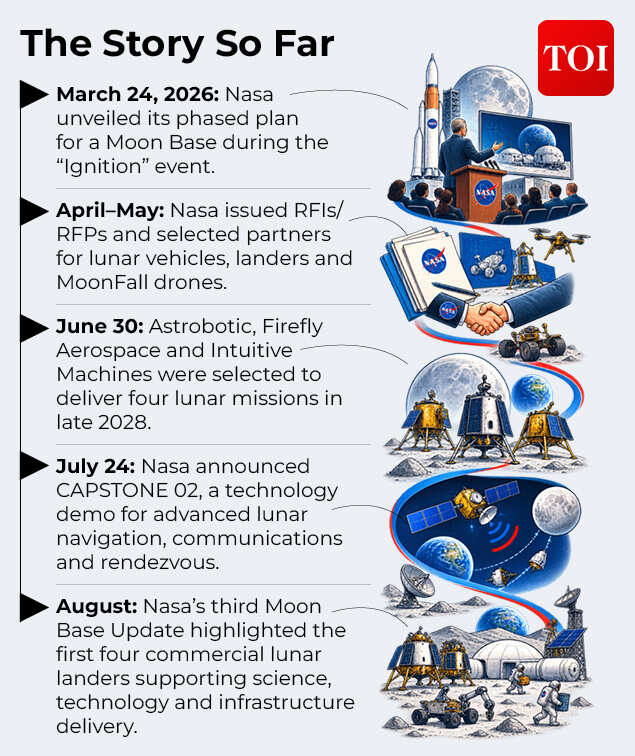
It is also part of a broader shift in how space agencies are approaching the Moon. Instead of one country building everything, Nasa is trying to create an ecosystem involving governments and commercial companies.That matters for India because participation could eventually provide opportunities in science, technology and industry. It could also give India a voice as rules and practices around lunar operations and resource use develop. But again, the scale of those benefits cannot yet be known.
So, what does the invitation mean?
The safest way to view it is as an opening rather than an outcome. Nasa is proposing a large, long-term lunar infrastructure programme. India has been invited to participate because it has demonstrated relevant capabilities and has an established relationship with the US in space.
Share your thoughts in the comments
Be respectful · TOI community guidelines
What India eventually contributes, what it gets in return and how important that contribution becomes will depend on what the two sides negotiate.There is plenty here that could become important for India. But the story, at this stage, is not that India is going to build the Moon Base with Nasa.It is that India has been invited to the table while the plan is still being built. And perhaps that is the more interesting story: what India chooses to ask for, offer and negotiate now could determine how significant its place in the next phase of lunar exploration eventually becomes.







Leave a Reply