
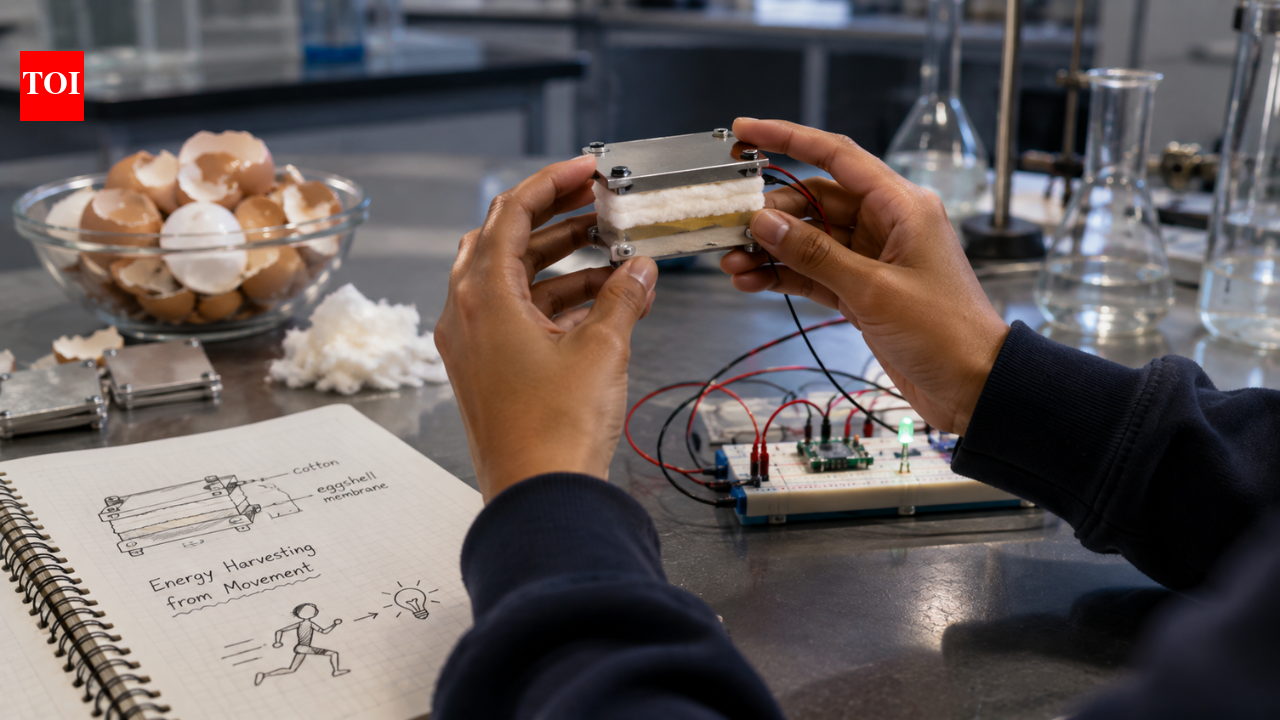
At 17, Meghana Addanki was looking at two materials that would rarely be associated with electricity: eggshell membrane and cotton. The New Jersey high school student used both in an experiment designed to turn ordinary movement into usable electrical energy, developing a small hybrid generator with the help of zinc oxide. Her project brought together piezoelectric and triboelectric effects, allowing the device to respond when it was pressed, tapped or otherwise subjected to mechanical force. The finished generator measured just 5 by 3 centimetres, yet produced considerably higher voltages than the individual material-based components tested during the research. In one test, forceful finger tapping generated a peak of 33.29 volts, while the device reached a power density of 26.4 microwatts per square centimetre. Presented at ISEF 2025, Addanki’s work explored whether natural, readily available materials could have a practical role in small-scale energy harvesting.
How eggshell membrane and cotton were modified with zinc oxide for energy harvesting
The unusual starting point for Addanki’s project was the thin membrane found inside an eggshell. Eggshells themselves are familiar household waste, but the membrane has a different composition and structure. In her project, it was used as the base material for one part of the generator. Cotton, meanwhile, formed the upper section, giving the device two biomaterial components with different electrical characteristics.According to the project description published by the Society for Science, both materials were treated with zinc oxide (ZnO), with the amount varied between 10 and 30 per cent by weight. The aim was not simply to make the materials conductive. The modified biomaterials were tested as piezoelectric nanogenerators, devices that can produce an electrical response when mechanical strain is applied. At the highest ZnO concentration tested, the cotton-based component produced a peak voltage of 7.55 volts, while the eggshell-membrane component reached 7.10 volts.
Eggshell membrane and mercerised cotton form a 5 by 3 centimetre hybrid nanogenerator
Addanki’s device did not depend on piezoelectric generation alone. She combined it with triboelectric generation, which uses electrical charge produced when different materials come into contact and separate. The two mechanisms were brought together in what the project describes as a hybrid piezo–tribo nanogenerator, or HNG.Its physical arrangement was part of the experiment. The generator measured 5 by 3 centimetres and used an arch-shaped configuration, with two biomaterial-based piezoelectric sections. The eggshell membrane acted as the tribopositive base component, while mercerised cotton was positioned as the tribonegative upper section. The shape was intended to increase strain in the upper part while allowing the contact-and-separation movement needed for triboelectric generation. It was a small structure, but its design involved combining two different energy-harvesting effects rather than treating them as separate systems.
Meghana Addanki’s hybrid nanogenerator reaches 33.29 volts during forceful finger tapping
The finished HNG was put through several mechanical tests to see how much electrical output it could produce. During weight-drop testing, a 1kg load was dropped from a height of 3cm at a rate of 5Hz. The generator recorded an average peak-to-peak voltage of 20.47 volts, with a variation of 2.20 volts, while its root mean square voltage was measured at 6.82 volts.The device was also tested using finger tapping, bringing the experiment closer to the kind of repeated movement that a small wearable or portable system might experience. Under forceful tapping of roughly 10 newtons at 3Hz, the HNG produced a peak output of 33.29 volts. Its reported power density reached 26.4 microwatts per square centimetre when connected to a 5-megaohm load. These measurements gave Addanki a way to compare the performance of the finished hybrid device with the individual biomaterial-based components tested earlier.
How Meghana Addanki’s natural-material generator could support wearable and portable electronics
The project grew out of a practical limitation in mechanical energy harvesting. Piezoelectric generators can produce electricity from deformation or movement, but some established versions rely on materials such as lead zirconate titanate, or PZT. PZT is toxic and brittle. Triboelectric generators offer another route, although their performance can be affected by environmental conditions and their electrical output can be limited depending on the materials and design.Addanki’s approach was to investigate whether natural materials could form part of a different kind of generator without giving up useful electrical performance. The resulting device was not presented as a replacement for large-scale power generation. Its intended relevance was much smaller: portable electronics, wearable technology and other self-powered systems that need modest amounts of energy generated from movement. At ISEF 2025, the work appeared under the Energy: Sustainable Materials and Design category, linking the material choice with the broader question of how everyday biological materials might be used in energy-harvesting technology.






Leave a Reply