
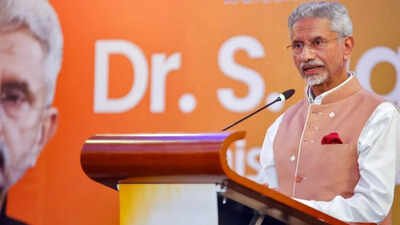
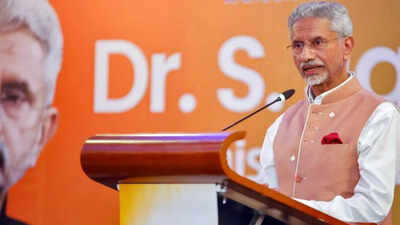
NEW DELHI: External affairs minister S Jaishankar on Saturday offered a candid assessment of a rapidly changing global landscape, warning that growing geopolitical and economic tensions are creating new challenges for countries and businesses. He also stressed that India must remain engaged with the world’s major economies while strengthening its own industrial and economic capabilities.Speaking at the Economic Times World Leaders Forum 2026, Jaishankar said the emerging global environment required countries to reduce vulnerabilities, broaden their economic options and prepare for disruptions rather than rely on assumptions of stability.He framed his assessment around three defining features of the present world order: competition, conflict and the growing use of economic and strategic leverage. To navigate these pressures, he proposed a four-part approach centred on reducing risks, diversifying partnerships and sources, addressing market distortions and maintaining a margin of safety.On China, Jaishankar said India should continue doing business with Beijing while developing the domestic strength needed to compete with it. He said greater self-reliance, industrialisation and manufacturing capacity would allow India to engage China more confidently rather than disengage from it.“We have to do business with the entire world. That includes China too. But it is important we deal with them confidently.”Jaishankar said India-China relations had gone through a difficult period between 2020 and 2024 because of the border situation, but both countries had an interest in maintaining stable ties. He also said India needed to make up for decades of shortcomings in building its manufacturing and industrial base.“So I think a stronger, more self-reliant India, a more industrialised India, a more manufacturing India will be able to actually compete with China as it will with other major countries of the world.”
Jaishankar’s 3Cs view of the world
“It’s not a very comforting answer I’m going to give,” Jaishankar said while describing how he sees the world today.He said the world had become increasingly competitive, with countries and policymakers pursuing their interests to a point where competition could turn into conflict.“I think what we’ve seen particularly in the last year or so, but I would really describe it as a growing trend. It looks increasingly competitive,” he said, adding that countries and policymakers were pushing their interests “to a point where you actually have conflicts.”He pointed to the Russia-Ukraine conflict and the conflict in West Asia as major examples, noting that one had entered its fifth year while there was still no clear “light at the end of the tunnel” for the other.Jaishankar said competition was no longer confined to traditional geopolitical rivalry, with economic and strategic tools increasingly being “weaponised”.“This is a world increasingly characterised by choke points,” he said, explaining that such a choke point emerges when “a country or a set of countries have established dominance” in a particular field and are prepared to use that dominance to exert pressure.According to Jaishankar, such leverage can “inflict pain” on others, while countries exercising it may believe they are sufficiently insulated from the consequences.
The 4Ds response
Jaishankar then outlined what he described as a response to these challenges.“If I declare the problems in terms of Cs, maybe I move an alphabet beyond,” he said, presenting derisking as his first and “biggest mantra”.“Derisking will be my biggest mantra,” Jaishankar said, stressing that the principle applied not only to businesses but also to politics and strategy.His second D was diversification.“The more partners, the more sources that you have, clearly extending that you derisk,” he said, arguing that countries and businesses should avoid excessive dependence on a small number of partners or sources.The third was dealing with distortions. Jaishankar pointed to disruptions in energy, fertiliser and shipping markets linked to conflicts and the emergence of choke points.For his final point, he urged businesses and policymakers to move beyond the traditional principle of “Trust and Verify”.“Today I say ‘Distrust and Diversify’,” he said, arguing that planning should take into account the possibility that “things may not go right”.He also warned against excessive reliance on just-in-time supply chains and the assumption that the lowest cost should always determine economic decisions.“Don’t let your supply chain really be just in time anymore; don’t assume that your lowest cost will be the determinant,” he said, stressing the importance of building a “margin of safety”.
India-China ties need stability
Turning to China, Jaishankar said India’s engagement with Beijing should ultimately help modernise the Indian economy and strengthen domestic capabilities, even as trade and other economic interactions continue.“But for us, the interaction is the purpose of it is finally to modernise our economy and to develop our capabilities, but even as we do so, obviously there will be trade, there will be other economic interactions with them.”He said India and China had experienced a particularly difficult phase between 2020 and 2024.“I think we went through a particularly bad patch between the summer of 2020 and the autumn of 2024, and that was primarily an outcome of the situation in the border”However, he said both countries remained major economies and markets for each other, and that greater cooperation could be possible if relations remained stable and moved in a more cooperative direction.At the same time, Jaishankar said India had to address the weaknesses created by decades of inadequate industrialisation.“We stand our ground as we have stood in the border. We develop our strengths, which unfortunately, as I said, from the 1960s for half a century, we did not do.”“We have to make up for the shortcomings and you know the the mistakes of the past, and and that is really what we are hoping to do.”Jaishankar said building a stronger manufacturing base would be central to India’s ability to compete with China and other major economies.
India has raised Chinese visa concerns
Jaishankar also acknowledged concerns among Indian businesses over difficulties obtaining Chinese business visas, saying the government had taken up the issue.“So, in seeing those stories about business visa issues, which our businessmen have been facing, yes, we have seen it, and I want to say, I mean, for those of you who may have an interest or who may have been affected, we have taken it up as well.”At the political and strategic level, he said both India and China had an interest in maintaining stable relations.“I would also say, at a political level, at a strategic level, they, you know, it’s both of us have an interest in maintaining a certain, you know, I would say stable relationship here.”Jaishankar cautions against US-China ‘G2’ narrativeJaishankar also urged caution over the idea of a US-China “G2”, saying the relationship between Washington and Beijing remained fundamentally competitive despite areas of cooperation.“I think people use that term. I would advise you to treat it with some caution, because the fact is, if you look at the US-China relationship, I think at its heart it’s a fundamentally competitive relationship.”He said the two countries could still cooperate in some areas and remain largely indifferent to each other in others.
Share your thoughts in the comments
Be respectful · TOI community guidelines
“But as is often the case, it can also be collaborative in certain matters. It can be indifferent in certain sectors.”He added that the US and China would not necessarily compete on every issue, in every geography or at every point in time.“So it is not that they will compete on every issue and every geography and every time flight.”Jaishankar concluded that the uncertainty confronting governments and businesses represented a broader shift in the global environment.“I think this is the reality of the world. It applies to national policymakers; it applies to enterprise decisions,” Jaishankar said, concluding: “I think it is a realistic picture.”



Leave a Reply