
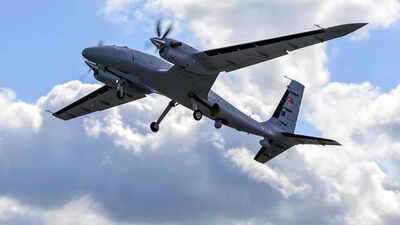
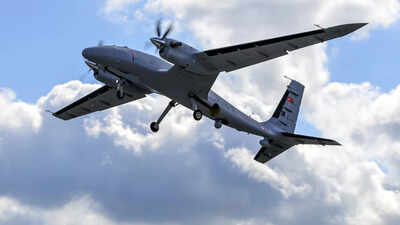
NEW DELHI: An unusual increase in Turkish military transport flights to Pakistan in the last few days has raised hackles in Indian defence circles.Open-source flight trackers noted a 60-hour surge of Turkish military transport flights, including Turkish C-130 Hercules and A400M aircraft (such as one with call sign TUAF526), landing at Pakistani air bases like Nur Khan, Masroor, and Murid between August 19 and 21.There is speculation in defence circles that the flights may have carried Turkish military hardware, including unmanned aerial systems (drones) and air-defence equipment like Baykar (next-generation kamikaze UAV K2) and Asisguard systems (drone systems) to Pakistan. The aircraft movements were seen soon after after the signing of the tripartite Mecca Joint Defence Agreement between Pakistan, Turkey, and Saudi Arabia on Aug 7. The agreement establishes a collective defence pact, stating that an armed attack against any one of the three member states will be considered an attack against all of them.However, neither Pakistan nor Turkey has officially confirmed the precise nature or cargo of these transport operations.With Turkish aircraft landing in Pakistan, questions are being raised in defence circles whether Pakistan is gearing up for another conflict with India.Before Operation Sindoor in May last year, China and Turkey had allegedly supplied Pakistan with advanced military hardware, including Chinese PL-15 air-to-air missiles and HQ-9 air defence systems, and Turkish-origin Bayraktar (Yiha) and Asisguard Songar kamikaze drones. They also provided real-time battlefield data and tactical support.
Share your thoughts in the comments
Be respectful · TOI community guidelines
During the four-day conflict last year, the Indian armed forces tackled these attacks using their multilayered air defence grid and integrated command and control strategy, successfully intercepting all incoming aerial threats before reaching critical military or civilian infrastructure.The Indian forces deployed indigenous technology and advanced anti-access frameworks to crush the Pakistan defence network and also thwarted its offensive attacks. The IAF used long-range capabilities of Russian-acquired S-400 Triumf air defence system and indigenous Akash-NG missiles to thwart missile and UAV attacks. The IAF also used the S-400 to shoot down a high-value Pakistani Saab 2000 Erieye AEW&C surveillance aircraft from around 314 km away — which stands as one of the longest-range combat surface-to-air missile engagements in military history.






Leave a Reply