
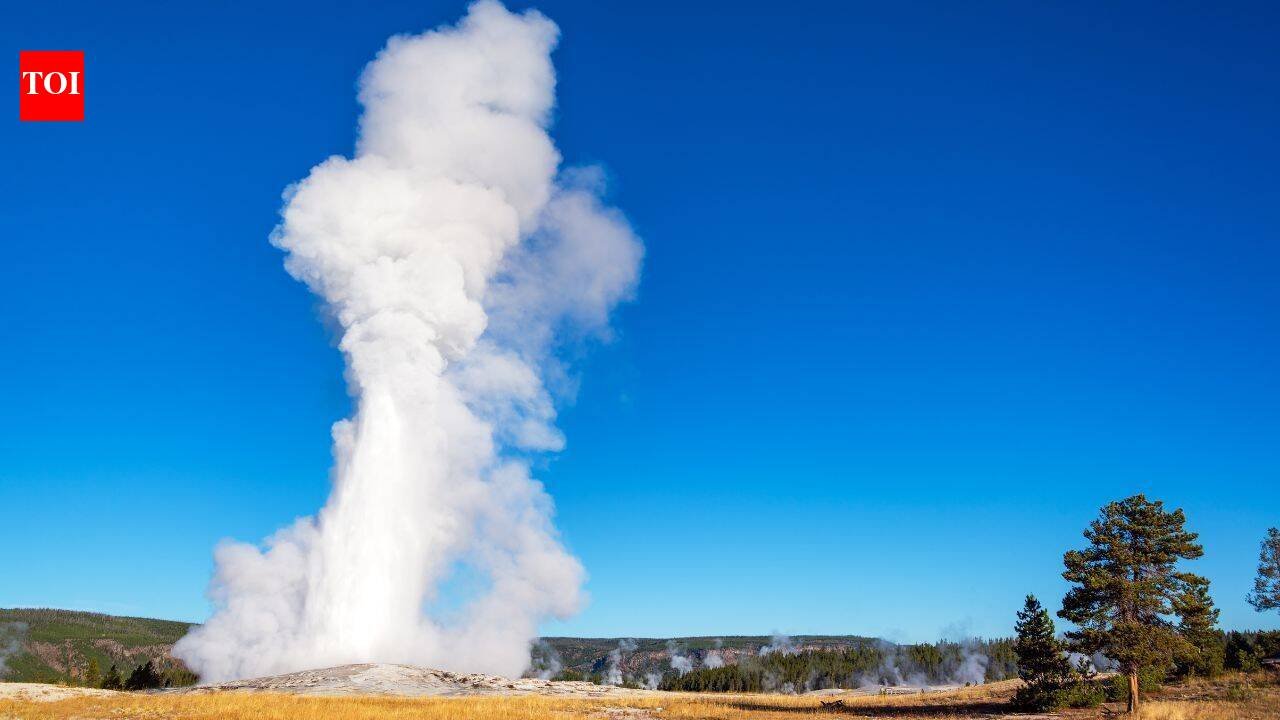
Old Faithful may be the world’s most famous geyser, but until recently, no one had a clear picture of the “plumbing” that powers its eruptions. In a landmark 2017 studytitled ‘Anatomy of Old Faithful From Subsurface Seismic Imaging of the Yellowstone Upper Geyser Basin’, University of Utah scientists deployed 133 small, portable seismometers around Old Faithful and nearby Geyser Hill for two weeks, listening to the faint hum of the ground between eruptions. By turning everyday micro-vibrations, caused by wind, water, tourists, and the geyser’s own boiling, into a usable signal, the team mapped a hidden reservouir of hot water beneath the surface. Their analysis suggests the reservoir can hold roughly 300,000 cubic meters of water, or about 79 million gallons. Based on the reportings from the University of Utah and the U.S. Geological Survey’s Yellowstone Volcano Observatory, here’s more details about the discovery:Why Old Faithful’s underground system was a mysteryOld Faithful erupts like clockwork every 44 to 125 minutes, drawing millions of visitors to Yellowstone National Park each year. Yet despite its fame, the near-surface geology and fluid pathways feeding the geyser were poorly understood. Deep magma reservoirs 5–40 km below the park provide heat, but the shallow “plumbing” that channels hot water to the vent had never been mapped in detail. Traditional seismic methods that rely on large earthquakes or active sources (like hammer strikes or small explosions) aren’t ideal in a sensitive, crowded tourist area. The National Park Service specifically asked researchers to survey the Old Faithful area to better manage buildings and walkways constructed over thermal features that can create excessive subsurface heat.Turning noise into a map: the 133-seismometer experimentTo capture the subtle signals, the University of Utah team used compact, autonomous seismometers developed for the oil and gas industry. Each unit is a white canister about six inches high, self-contained and inexpensive compared to traditional instruments that can cost over $10,000. In 2015, researchers placed 133 of these sensors around Old Faithful and Geyser Hill for a two-week campaign, creating a dense network capable of detecting tiny ground movements.Instead of creating their own seismic source, the scientists treated ambient noise as data. They used continuous ground shaking from humans, cars, wind, water, and Yellowstone’s hydrothermal activity, then extracted coherent signals from the background vibration. Doctoral student Sin-Mei Wu and co-author Fan-Chi Lin developed analysis methods that correlated signals from sensors near persistent hydrothermal sources to others across the array, effectively using the geyser system itself as a seismic source. This approach allowed them to image shallow structures without disturbing the fragile environment of the Upper Geyser Basin.What the tremors revealed: a giant hidden reservoirThe sensors recorded a striking pattern: bursts of intense seismic tremors around Old Faithful lasting about 60 minutes, separated by roughly 30 minutes of quiet. Counterintuitively, the eruption does not occur at the peak of shaking but at the end, just before the tremors subside. After an eruption, the geyser’s underground cavity refills with hot water. As it fills, pressurized bubbles rise, cool rapidly, and implode; the energy from these implosions generates the pre-eruption tremors.When analyzing the data, the team noticed that tremor signals from Old Faithful were not reaching the western boardwalk. Seismic waves from another hydrothermal feature to the north also slowed and scattered in nearly the same area. With the dense sensor network, they could pinpoint the shape, size, and location of the anomaly: Old Faithful’s hydrothermal reservoir. Wu estimates the reservoir—a network of cracks and fractures through which water flows, is about 200 meters in diameter, slightly larger than the University of Utah’s Rice-Eccles Stadium, and can hold approximately 300,000 cubic meters of water, or more than 79 million gallons. By comparison, each eruption releases only around 30 cubic meters (nearly 8,000 gallons), meaning the reservoir is vastly larger than any single eruption.Why this matters for science and park managementMapping Old Faithful’s underground system does more than satisfy curiosity. It helps park managers understand where heat and fluid flow beneath buildings, walkways, and visitor areas, informing safer infrastructure planning in one of the world’s most visited geothermal zones. The study also demonstrates a powerful, low-impact method for imaging shallow geology in sensitive environments by leveraging ambient noise instead of active sources.For researchers, the work opens new questions about how subsurface structures change over time and how seismic waves propagate through hydrothermal systems. The team returned for additional surveys in 2016 and planned further deployments, aiming to produce even higher-resolution images and explore other basins like Norris, the park’s hottest geothermal area. As Fan-Chi Lin noted, breakthroughs in Yellowstone depend on both new techniques and long-term relationships with the park: a reminder that some of the most iconic natural wonders still have secrets waiting beneath the surface.






Leave a Reply