
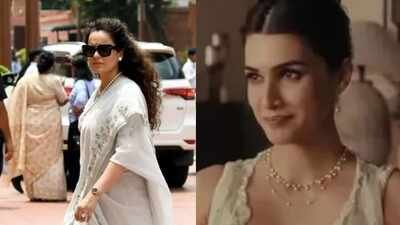
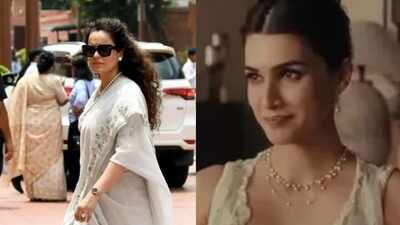
MP and actor Kangana Ranaut has clarified her earlier criticism of Kriti Sanon’s controversial Raksha Bandhan advertisement, stressing that her remarks were not directed at the actor personally but were rooted in a broader discussion about the cultural significance of Indian festivals. According to Kangana, festivals are “not just about aesthetics” but an “expression of a culture and civilisation.”Kangana had previously taken issue with Kriti’s styling in the GIVA campaign, describing it as “intentionally creepy” and questioning the choice of a bralette-style outfit while the actor was shown tying a rakhi to her brother.In a recent interview with Sudhir Chaudhary, Kangana was asked about her remarks on the advertisement, as well as Congress leader Rahul Gandhi’s comments on women having the freedom to decide what they wear and how they live. Responding to the discussion, she maintained that her comments were focused on the larger issues represented by such examples rather than the individuals involved.Addressing the argument that women should have complete freedom over their clothing choices, Kangana said, “Who is stopping them from wearing anything, given the kinds of films we see them in? Who even cares what they come wearing?”She went on to argue that personal choices cannot always be separated from the cultural setting in which they are presented. “How can one have such a foolish way of thinking? The aesthetic expression of any civilisation is its festival,” she said.Speaking specifically about Raksha Bandhan, Kangana said the festival carries its own religious and civilisational traditions and should therefore be represented with an understanding of those customs.“Raksha Bandhan is a religious and civilisational expression. It has its own rules, just as there are rules for worship,” she said.Kangana also took aim at Rahul Gandhi’s comments, describing his views as “confused” while questioning his understanding of patriarchy. During the conversation, she was also asked whether an advertisement with a similar visual treatment could be created for Eid. Kangana responded by highlighting what she believes are the distinct cultural expectations attached to Indian festivals.“But in our culture, there is so much dignity in every relationship, so many traditions, lines and boundaries,” she said.Addressing the controversy surrounding the campaign’s withdrawal, Kangana argued that the outfit itself was only a small part of the issue. “The bralette was a very small part of the bigger issue,” she said.According to the actor-politician, the bigger concern was that the advertisement did not feature several elements traditionally associated with Raksha Bandhan celebrations. “For Hindus, the real question was—where are the parents? Where is the home? There was no halwa, puri, God, tilak, akshat, incense or lamp—nothing,” she said.Elaborating on her point, Kangana added, “Festival is not just about aesthetics. A festival is an aesthetic expression of a culture and civilisation.”The GIVA Raksha Bandhan campaign had sparked considerable debate on social media, with several users objecting to Kriti’s bralette-style blouse and the manner in which the festival was portrayed. The advertisement was subsequently withdrawn. While some critics questioned why similar creative choices were not being made for advertisements centred around festivals such as Eid or Christmas, others accused the campaign of hurting religious sentiments.One social media user described the campaign as a “mockery of sacred traditions” and called for police action, while another criticised Kriti’s choice of outfit while tying a rakhi.The controversy has since become part of a wider conversation about the representation of Indian festivals in advertising, particularly the balance between contemporary aesthetics and traditional cultural symbolism.Kangana also defended her decision to comment on such issues, maintaining that her responsibilities extend beyond personal concerns now that she is both a public figure and an elected representative.





Leave a Reply