
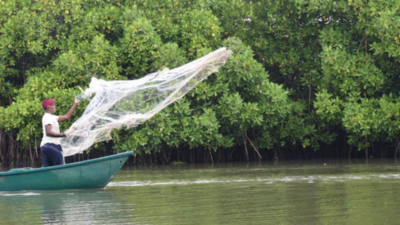
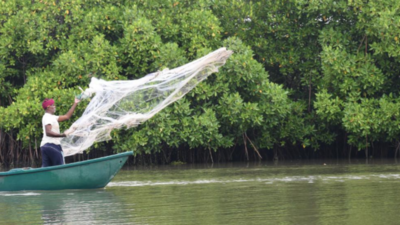
In the 1980s, when much of Gujarat’s coastline was losing its mangrove cover, some coastal communities began protecting the few patches that remained. What looked like a small act of conservation would eventually become part of one of India’s most striking mangrove recoveries.Government data shows just how dramatic that transformation has been.According to the Forest Survey of India (FSI), Gujarat had around 427 sq km of mangrove cover in 1987. By 1999, that figure had more than doubled to 1,031 sq km. It reached 1,164.06 sq km in 2023, making Gujarat home to nearly one-quarter of India’s mangrove cover. In 2026, the cover has grown to 1177.27 sq km.It attributes the growth to a combination of large-scale plantation programmes, public-private partnerships, community participation and better protection of existing forests.Mangroves are much more than trees growing in salty mud.Their dense network of roots holds sediment together, reduces coastal erosion and slows waves and storm surges before they can reach settlements further inland. The forests also provide breeding and nursery grounds for fish, crabs and other marine species, making them important to both coastal ecosystems and livelihoods.The numbers also reveal how significant Gujarat’s recovery has become. The state’s 1,164 sq km of mangroves in 2023 accounted for 23.66% of India’s entire mangrove cover, second only to West Bengal.But the recovery has not been a simple story of trees being planted by the government. In several parts of Gujarat, conservation efforts have involved coastal communities in protecting and regenerating mangrove areas. That local involvement matters because mangroves occupy a difficult landscape — one constantly shaped by tides, salinity, grazing, cutting and human activity.The government has now taken the approach nationwide through MISHTI, launched in 2023 to restore and promote mangrove ecosystems along India’s coast. Under the programme, mangroves are increasingly being treated as natural infrastructure — ecosystems that can perform some of the protective functions that would otherwise require expensive coastal engineering.
Share your thoughts in the comments
Be respectful · TOI community guidelines
Gujarat’s story therefore offers an unusual lesson in climate protection: sometimes the most effective coastal defence is not something built against the sea.It is something that grows between the land and the sea.And in Gujarat, decades after villagers began protecting those seemingly insignificant patches of mangrove, they have grown into forests spanning more than 1,100 sq km — forming a vast, living barrier along one of India’s most exposed coastlines.







Leave a Reply