
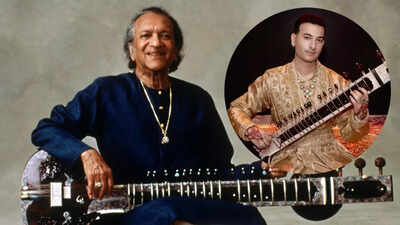
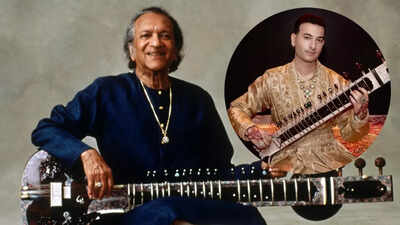
Days after Anoushka Shankar publicly clarified that her father, Pandit Ravi Shankar, was never the guru of sitarist Rishab Rikhiram Sharma, the Ravi Shankar Centre has issued a detailed statement of its own. Firmly rejecting Rishab’s assertion that he was Ravi Shankar’s disciple — let alone his youngest or last — the Centre laid out a clear timeline, challenged photographs previously shared by the musician, and sought to address what it described as misunderstandings around instruction and the meaning of discipleship.In its note, the Centre said the clarification was issued to “correct inaccurate timelines, wrong perceptions around the nature and amount of instruction given by Guruji, and confusion around the term disciple.”Explaining the circumstances under which Ravi Shankar first met Rishab and the maestro’s health at the time, the statement noted, “On 3 January 2012, at the persuasion of Rishab’s father, and due to affection for the young child, an informal string-tying took place at the Centre between Guruji and Rishab. Such ceremony was neither conducted as a formal Ganda-Bandhan Ceremony nor was it conducted according to traditional custom.”The Centre said that this ‘informal ceremony’ lacked every element of a formal initiation. There was no priest present, no ceremonial thread prepared, and no official announcement made. No students, extended family members, or friends attended the occasion either. “For the record, other than Guruji and his wife, from the Centre only Guruji’s one senior disciple, namely, Parimal Sadaphal was present. Guruji did not conduct a formal initiation discourse, and he did not conduct several hours of teaching that day. The mentioned ceremony was entirely impromptu. The event has been retrospectively amplified beyond what occurred,” the statement said.The Centre also addressed Ravi Shankar’s appearance at Rishab’s concert a month later. “On 10 February 2012, Guruji attended a concert by Rishab at Kamani Auditorium in a wheelchair, agreed to introduce him to the audience, and while doing so said ‘I have just had this new, wonderful young boy become my student, and just given him few lessons.’ Neither at the said concert nor at any time thereafter did Guruji call Rishab his disciple,” it clarified. The note added that during the concert itself, Ravi Shankar’s health deteriorated significantly, after which he was unable to provide any meaningful instruction.Between 3 January and 9 March 2012, the Centre said that Ravi Shankar and Parimal Sadaphal gave Rishab only a “few classes,” and not the prolonged sessions that have been claimed. Further lessons were conducted by Arun Bharat Ram. “On 9 March 2012, Guruji returned to the United States, and after that date gave no further lessons, phone calls, or supervision to Rishab. On 12 December 2012 Guruji passed away. Any claim of prolonged, ongoing, or remotely supervised instruction by Guruji to Rishab beyond 9 March 2012 is therefore incorrect,” the statement read.The Centre also dismissed claims that Ravi Shankar had seen Rishab’s YouTube videos before the ceremony or had chosen to mentor him on that basis, stating that no such viewing or decision took place.Addressing the broader issue, the Centre underlined that within the parampara of Indian classical music, the term ‘disciple’ holds profound significance. “It is not symbolic, and it is not established through an informal moment. It is a relationship that evolves over many years of guidance and shared commitment. A few lessons and a brief appearance in a concert/video cannot be considered equivalent to that level of formal, rigorous and immersive training and commitment,” the note explained.



Leave a Reply