
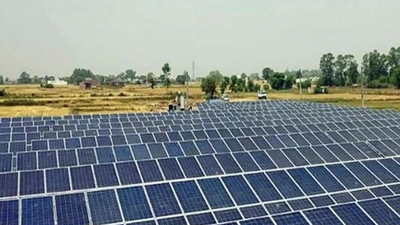
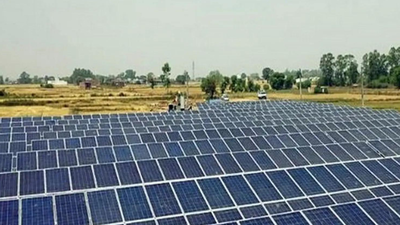
NEW DELHI: India has, for the first time, surpassed the US to become the world’s second-largest market for annual solar capacity additions, the ministry of new and renewable energy said on Wednesday.Quoting the latest International Renewable Energy Agency (IRENA) report, the ministry said India added more than 37 GW of solar capacity in calendar year 2025, compared with 34 GW in the US. China continued to lead the world, adding nearly 315 GW of solar capacity in a single year.Pralhad Joshi, minister of new and renewable energy, said India was driving record capacity additions through “strong policy support, innovation and world-class infrastructure”.“India’s clean energy transition is accelerating, strengthening energy security, advancing sustainable development and reinforcing India’s position as a global leader in renewable energy,” Joshi said.According to the report, India’s installed solar capacity increased from 98.5 GW in 2024 to 135.5 GW in 2025. In comparison, the US expanded its solar capacity from 177.6 GW to 211.6 GW during the same period.Globally, solar power capacity grew by 512 GW over the year, rising from 1,880 GW in 2024 to 2,392 GW in 2025.The ministry also said India surpassed Japan to become the world’s third-largest solar power producer in 2025. The country generated 108,494 GWh of solar power during the year, compared with 96,459 GWh generated by Japan.Highlighting the pace of growth, the ministry said India achieved the milestone with unprecedented speed and scale. “From 2.7 GW in 2014, it took 96 months to reach the 50 GW mark in 2022. Capacity increased from 50 GW to 100 GW in 36 months (2022-2025) and from 100 GW to 150 GW in just 14 months (Jan 2025-March 2026),” an official said.In FY26, India recorded its highest-ever annual solar capacity addition of 44.6 GW, compared with 23.8 GW in FY25.Subrahmanyam Pulipaka, chief executive officer of the National Solar Energy Federation of India, said India’s rise from a nascent solar market to a global clean energy powerhouse demonstrated the strength of long-term policy vision, regulatory certainty and sustained industry participation.“India stands as a global example for both developed and developing economies, proving that rapid industrial growth and renewable energy expansion can progress together, with clean energy increasingly becoming the foundation of next-generation industrialisation and economic competitiveness,” he said.







Leave a Reply