

PM Modi formally launched the Viksit UDAN scheme on July 4 during the inauguration of the new terminal building at Jodhpur Airport
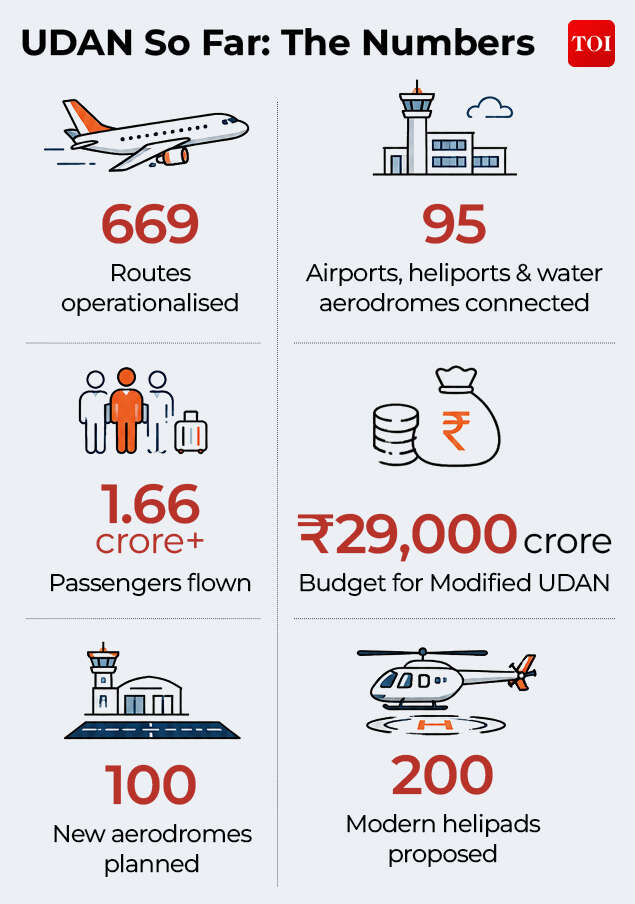
When the government launched the UDAN scheme in 2016, it carried a simple but ambitious promise: make flying affordable enough for even a person wearing hawai chappals to board a hawai jahaz.Nearly a decade later, that vision has reshaped India’s aviation map.Small airports that had remained unused for years were revived. Towns that had never seen scheduled commercial flights were connected to larger cities. Regional air travel moved beyond metros and became part of India’s broader infrastructure expansion story.Under UDAN, more than 1.66 crore passengers have travelled across 669 operational routes connecting 95 airports, heliports and water aerodromes.The scheme has also helped expand aviation access to remote, hilly and underserved regions where commercial airlines had earlier found operations difficult.But the journey has not been without turbulence.While hundreds of routes were launched, many struggled to survive after initial government support ended. Several smaller airlines either exited the market or reduced operations because of rising costs, limited passenger demand and operational difficulties.
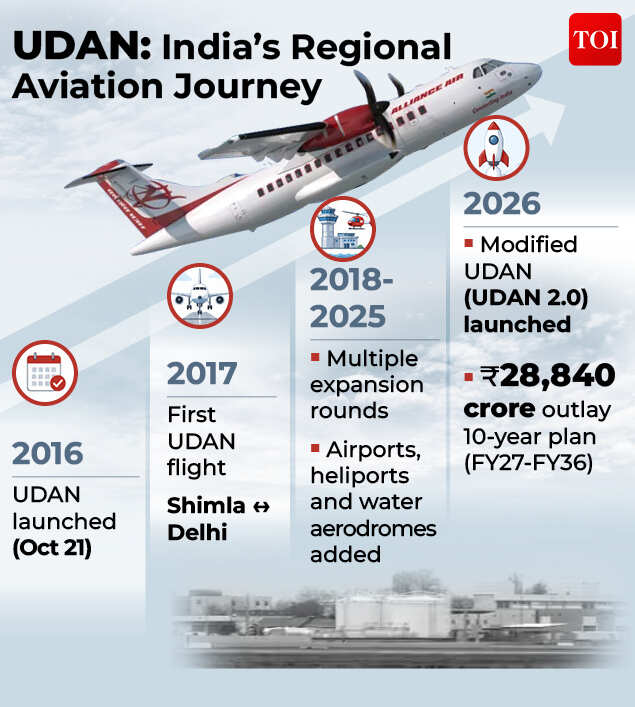
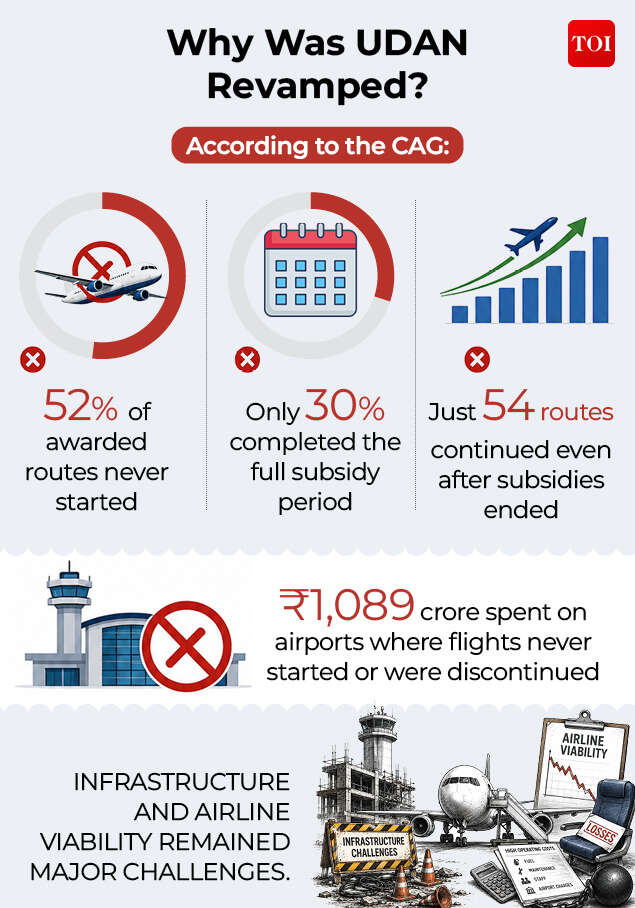
In some cases, airports were developed but flights could not sustain themselves. In others, airlines received route approvals but infrastructure constraints delayed operations.These challenges were also highlighted by the Comptroller and Auditor General (CAG) in its 2023 audit of the scheme’s first three phases.The audit found that while UDAN succeeded in expanding regional connectivity, long-term commercial sustainability remained a major challenge. According to the report, of the 774 routes awarded until UDAN-3, only 371 had commenced operations. Further, only 112 routes completed the full three-year concession period, and just 54 routes continued operating beyond the subsidy period as of March 2023.The findings underlined a fundamental challenge for regional aviation: government support could help airlines start operations, but ensuring routes survived beyond government support required stronger infrastructure, consistent demand and better planning.Recognising these limitations, the Union Cabinet in March approved the Modified UDAN Scheme, with a total outlay of Rs 28,840 crore for the next ten years.Prime Minister Narendra Modi formally launched the next phase, branded as Viksit UDAN, on July 4 during the inauguration of the new terminal building at Jodhpur Airport.Unlike the earlier version, the revamped scheme is not limited to subsidising airline tickets. It aims to create a complete regional aviation ecosystem by developing airports, supporting their operations, expanding helicopter connectivity, extending airline assistance and encouraging the use of indigenous aircraft.The changes are intended to make regional aviation more sustainable while strengthening links between smaller cities and the national economy.But the key question remains: can a bigger budget solve the problems that limited the first phase?Can longer subsidies ensure airlines continue flying after government support ends? And will UDAN 2.0 finally create a self-sustaining regional aviation network?
What exactly is UDAN?
UDAN, or Ude Desh ka Aam Nagrik, is India’s Regional Connectivity Scheme designed to make air travel affordable and improve connectivity between smaller cities and larger urban centres.Before its launch, Indian aviation was largely concentrated around metropolitan cities. While major airports expanded rapidly, several smaller towns either had limited air connectivity or remained completely outside the commercial aviation network.
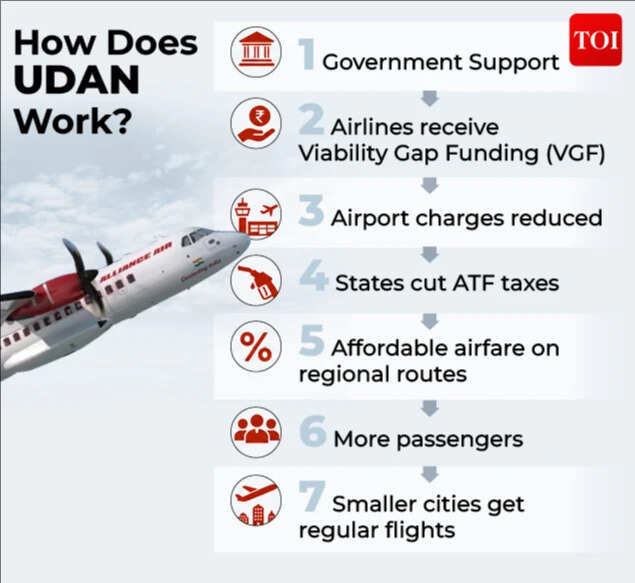
For airlines, operating flights to these destinations was often financially difficult. Passenger numbers were uncertain, aircraft utilisation was lower and operational costs remained high. This created a cycle where airlines avoided smaller routes because demand was limited, while passengers had fewer opportunities because flights were unavailable.UDAN attempted to break this cycle through government support.The scheme introduced a combination of incentives. Airlines operating regional routes received Viability Gap Funding (VGF) to compensate for losses and maintain affordable fares. Ticket prices on selected routes were capped to ensure accessibility for passengers.Airport operators provided concessions, while state governments were encouraged to reduce aviation taxes and provide support services at lower costs.The objective was straightforward: reduce operating costs for airlines, keep fares affordable for passengers and gradually develop enough demand for routes to become commercially viable.The first UDAN flight took off on April 27, 2017, connecting Shimla and Delhi, marking the beginning of one of India’s largest regional aviation initiatives.
Why did UDAN need a reboot?
The first phase demonstrated that there was demand for regional connectivity, but it also exposed the difficulty of sustaining aviation services in smaller markets.
Many routes that received government support struggled once the subsidy period ended. Regional airlines faced multiple challenges, including high fuel costs, limited aircraft availability, difficulty accessing major airports and uncertain passenger volumes.The CAG audit highlighted several of these implementation gaps.Apart from route sustainability, the auditor pointed to delays in airport development. It noted that despite expenditure on infrastructure, operations could not begin or were discontinued at several locations.According to the report, out of 116 airports, heliports and water aerodromes where expenditure was incurred during the audit period, operations started at only 71.The CAG also noted that operations could not commence or were discontinued at 83 airports, heliports and water aerodromes even after an expenditure of Rs 1,089 crore.The findings reflected a broader problem: building infrastructure alone does not guarantee connectivity. Airports require airlines, passengers and operational support to become sustainable.
Aviation industry experts believe the success of UDAN should now be measured beyond the number of routes launched or airports connected. The focus, they argue, should shift towards whether regional connectivity is creating sustainable economic activity around these locations.Ashish Chhawchcharia, partner and aviation industry leader at Grant Thornton Bharat, told TOI that the debate around UDAN must move beyond “the number of airports inaugurated or routes launched” and focus on the “quality and sustainability of connectivity being created”.“Regional aviation goes beyond a transport initiative to being an economic development tool. It is interesting to note whether these routes stimulate trade, tourism, investment and mobility in a way that creates lasting demand,” he said.According to Chhawchcharia, regional connectivity succeeds when aviation becomes part of a larger economic ecosystem rather than operating as an isolated transport service.Industry stakeholders have similarly argued that regional aviation needs better coordination between airports, airlines and government agencies.For smaller carriers, access to major airports remains a key concern. Without connectivity to large aviation hubs such as Delhi or Mumbai, regional routes often struggle to attract enough passengers.Another challenge has been the availability of suitable aircraft. Many smaller cities require aircraft with lower capacity that can operate efficiently on short routes. Limited availability and high leasing costs have restricted expansion by regional operators.The government believes the Modified UDAN Scheme addresses many of these weaknesses by shifting focus from only route subsidies to broader structural reforms.
What changes under UDAN 2.0?
The biggest change under the revamped scheme is the focus on airport creation and modernisation.The government plans to develop 100 airports from existing unserved airstrips with an investment of Rs 12,159 crore.Instead of building new airports everywhere, the approach focuses on upgrading existing airfields that have potential but lack passenger terminals, navigation systems or operational infrastructure.
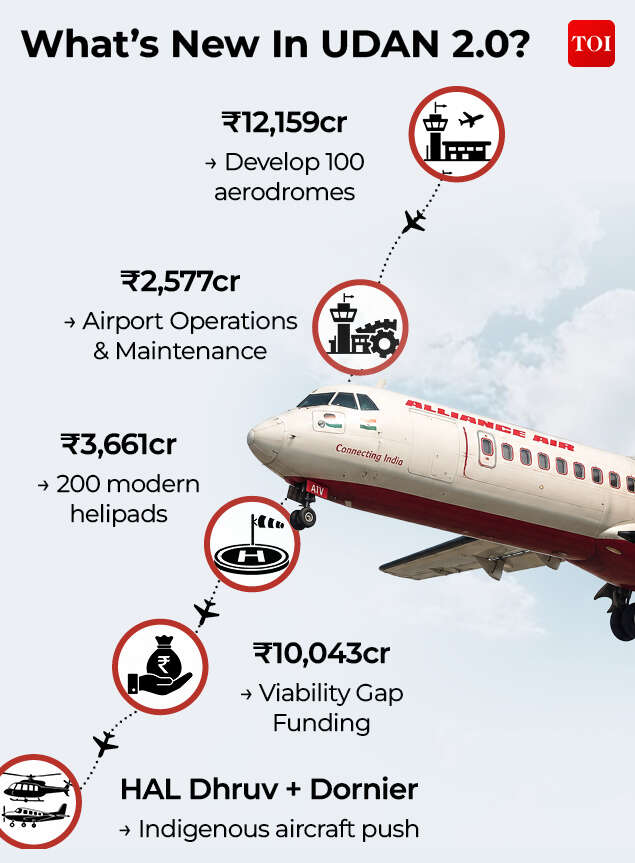
The scheme also introduces dedicated support for airport operations and maintenance.Regional airports often struggle during their initial years because passenger traffic takes time to develop. To address this, the government has allocated Rs 2,577 crore for operations and maintenance support for around 441 aerodromes.The support is aimed at helping airports remain functional until passenger volumes improve and revenues become more stable.
Expansion of helipads, longer support and indigenous aircraft
The revamped scheme also focuses on improving connectivity in regions where conventional airports are difficult to develop.Under Modified UDAN, the government plans to build 200 modern helipads with an investment of around Rs 3,661 crore. These will focus on hilly regions, island territories, border areas and aspirational districts where geography often makes road and airport connectivity challenging.The government believes these helipads can improve not only passenger movement but also emergency response, disaster management and healthcare access.For remote areas, helicopters can provide faster connectivity during medical emergencies, natural disasters and other situations where conventional transport infrastructure may not be sufficient.Another major change is the extension of financial support for airlines.The scheme has allocated Rs 10,043 crore for Viability Gap Funding (VGF) over ten years to support regional airline operations.The extended financial backing is intended to give airlines more time to build passenger demand before routes are expected to stand on their own.The government has also linked UDAN with its broader push for self-reliance in aviation.As part of the Modified UDAN Scheme, the government plans to support the induction of indigenous aircraft and helicopters, including HAL Dornier aircraft and HAL Dhruv helicopters, for operations in underserved regions.The move is expected to strengthen regional connectivity while supporting India’s domestic aerospace manufacturing ecosystem.
Can UDAN 2.0 succeed where the first phase struggled?
The success of the revamped scheme will depend on more than just financial allocation.Experts caution that subsidies can help create a market, but cannot permanently replace one. The long-term success of regional aviation will depend on whether connectivity is aligned with economic activity, tourism potential, industrial clusters and emerging consumption centres.
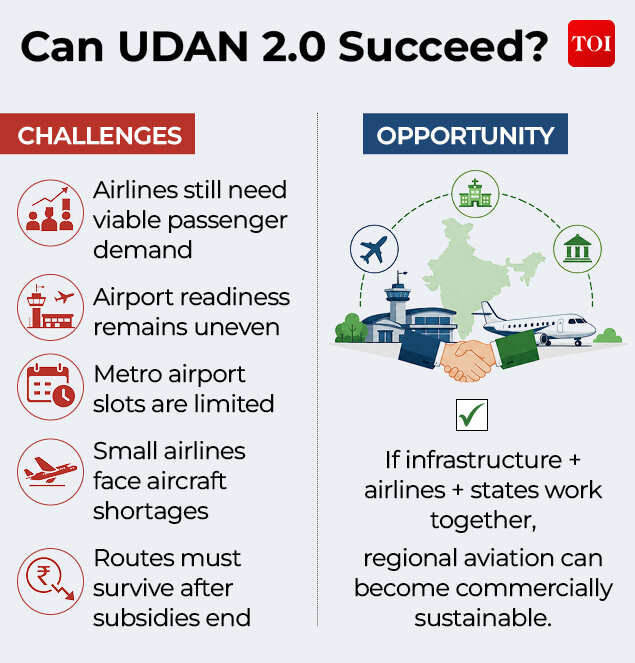
Chhawchcharia said the government’s expanded support under Modified UDAN reflects the strategic importance of regional connectivity, but financial assistance alone cannot guarantee sustainability.“While subsidies can help create a market; they cannot be a substitute for one,” he said.He added that India needs a more holistic approach where infrastructure development, airline economics, fleet availability, maintenance capabilities and local demand generation work together.Airports must be ready before airlines begin operations. Airlines need access to suitable aircraft. Smaller carriers require reasonable access to major aviation hubs. States must continue providing tax concessions and operational support.The CAG audit had highlighted similar implementation challenges during the first phase.Apart from delays in airport development, the auditor also pointed towards gaps in monitoring and oversight mechanisms. It noted issues related to verification of airline claims, delays in Regional Air Connectivity Fund processes and the need for stronger compliance monitoring.While these issues were administrative in nature, they showed that expanding regional aviation requires effective execution along with financial support.The government has attempted to address some of these concerns in the new framework by increasing airport maintenance support, extending VGF assistance and focusing on infrastructure creation.However, commercial viability remains the biggest challenge.Flying an aircraft to a smaller city may be socially beneficial, but airlines ultimately need sufficient passenger demand to sustain operations. A route that remains dependent on subsidies indefinitely cannot become a successful aviation market.The question of whether India should build airports first or wait for demand to emerge remains central to regional aviation planning.Chhawchcharia believes building infrastructure ahead of demand is not necessarily the wrong approach for a fast-growing economy like India, but it must be linked to credible economic potential.He pointed to Gulf aviation hubs such as Dubai and Abu Dhabi, where airport development and airline expansion were supported to attract global business, tourism and investment. However, he cautioned that India’s scale and diversity make careful planning essential.“The Indian government seems to be pursuing a strategy of building airports first in order to build an ecosystem around it. Looking at the Gulf example, this could be successful but needs to be crafted very carefully in a large country like India or else we face the risk of empty airports and failing carriers,” he said.The challenge for UDAN 2.0 will therefore be to ensure that government support acts as a bridge towards sustainability rather than becoming a permanent requirement.
Why UDAN matters beyond aviation
The importance of UDAN extends far beyond the number of flights it operates.Better air links can become a major driver of economic development by improving access to markets, tourism destinations, healthcare facilities and educational institutions.For smaller cities and towns, an airport can transform economic opportunities. Better connectivity can attract businesses, encourage tourism and make it easier for entrepreneurs and professionals to access larger markets.
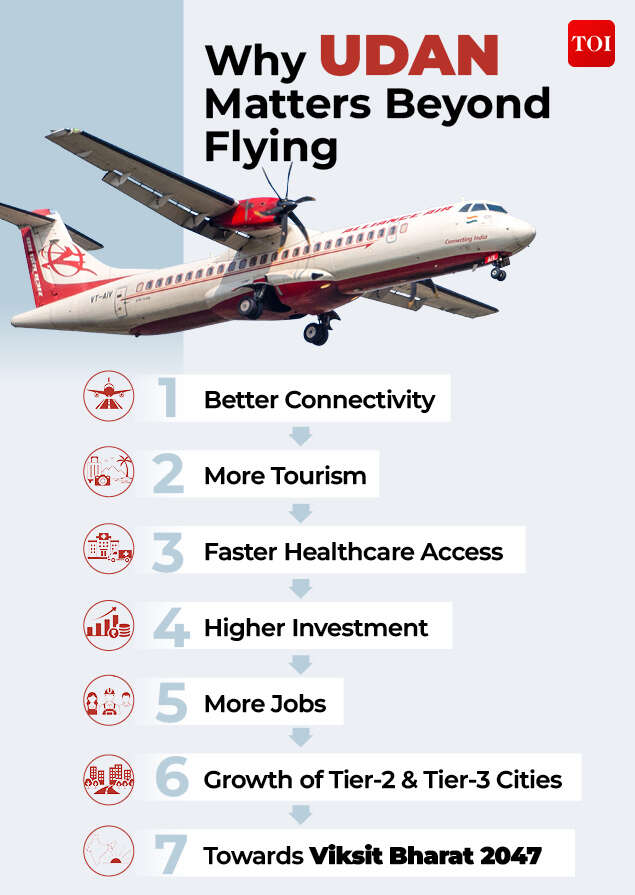
The scheme has also supported specialised initiatives such as Krishi UDAN, which aims to improve air cargo connectivity for agricultural produce, particularly from remote, hilly and northeastern regions.For farmers growing perishable products, faster transportation can improve market access and reduce losses.Similarly, improved aviation connectivity can be especially valuable for remote regions where travelling by road can take several hours or even days.The government believes the next phase of UDAN will help integrate Tier-2 and Tier-3 cities more closely into India’s growth story.
Can India make regional aviation sustainable?
India’s aviation sector has undergone a dramatic transformation over the past decade.The country’s airport network has expanded rapidly, passenger traffic has increased and flying has gradually moved from being a luxury associated mainly with metropolitan India to a more accessible mode of transport.UDAN has played an important role in that transition.The scheme proved that there was demand for air connectivity beyond major cities. It brought previously ignored airports back into operation and encouraged airlines to explore markets that were earlier considered commercially unattractive.But the first phase also showed that connectivity cannot be created only through subsidies.The CAG’s findings highlighted a central lesson: launching routes is easier than keeping them operational. Sustainable regional aviation requires reliable infrastructure, efficient airlines, adequate demand and strong monitoring mechanisms.The Modified UDAN Scheme attempts to address these gaps by moving beyond just airfare support towards building the wider aviation ecosystem.With nearly Rs 29,000 crore committed over the next decade, the government is betting that better infrastructure, longer financial support and indigenous aircraft capability can make regional aviation more durable.Whether UDAN 2.0 succeeds will ultimately depend on execution.The true measure of UDAN 2.0 will not be the number of routes announced or airports inaugurated, but whether those investments create lasting regional economic growth. As Chhawchcharia puts it, “The next phase of UDAN should therefore be judged not by how much support is provided, but by how effectively it converts public investment into self-sustaining regional economic growth,” he said.If implemented effectively, the revamped programme could help create aviation networks beyond traditional hubs such as Delhi, Mumbai and Bengaluru, bringing smaller towns closer to India’s growth story — making the skies accessible for every Indian.







Leave a Reply