
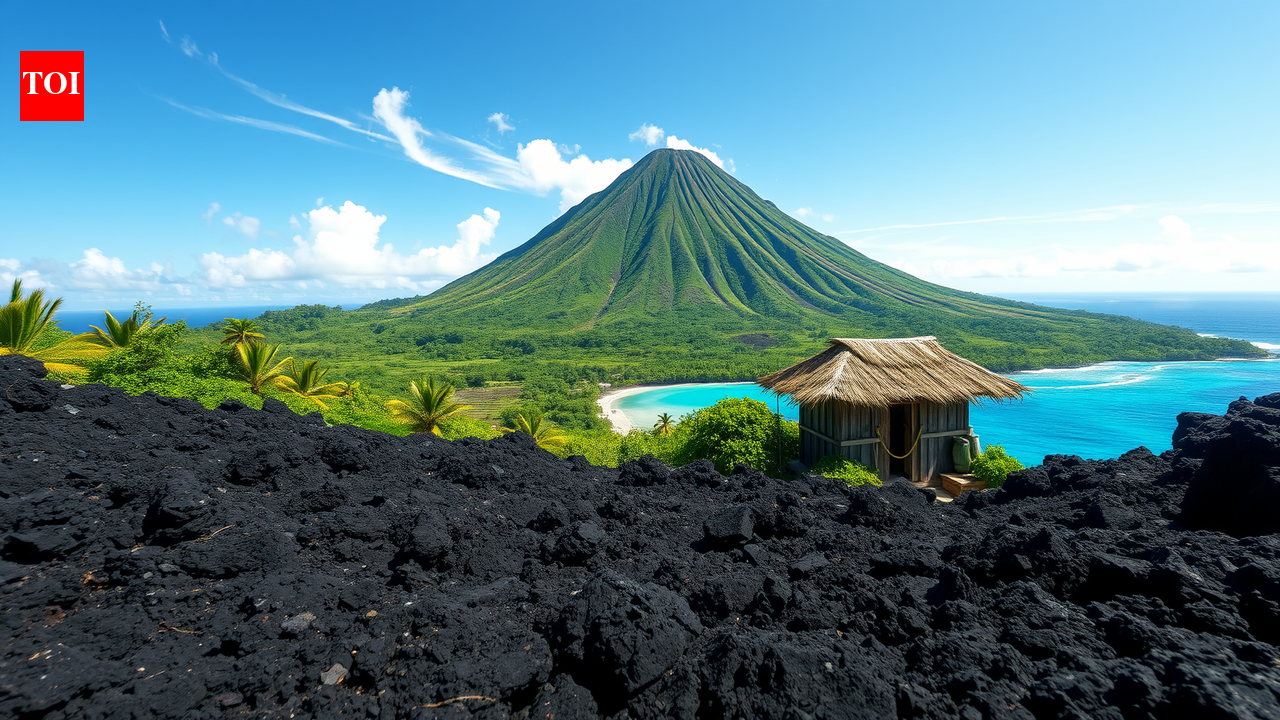
Far out in the western Pacific, in a chain of islands that form part of United States territory, sits Pagan, one of the most active volcanoes in the entire Mariana Islands arc. The island was completely evacuated in 1981 after a major eruption forced its small community to flee, and it has remained largely uninhabited ever since. Current population figures put the island’s residents at just two people, though only one, a man who has drawn attention online after being featured in a travel documentary, has had his life on the island documented in any detail. He has spent years living there, on a volcanic island still closely monitored for eruptions by American geological agencies. The island itself, its volcanic history and its official hazard status are all matters of public scientific record.
What makes Pagan Island one of the most active volcanoes in US territory
According to the United States Geological Survey, Pagan is the largest and one of the most active volcanoes in the Mariana Islands, made up of two stratovolcanoes connected by a narrow strip of land. The northern volcano, Mount Pagan, rises 570 metres above sea level and accounts for almost all of the island’s recorded historical eruptions, including the major 1981 event. The smaller southern volcano stands at 548 metres and has only one confirmed eruption in the historical record, in 1864, according to the Smithsonian’s Global Volcanism Program, and has otherwise shown only fumarole and steam activity rather than further eruptions.The USGS records historical eruptions at Pagan dating back to the 17th century, almost all of them originating from Mount Pagan in the north. Because of its continued activity, Pagan is classified as carrying a high threat potential under the National Volcano Early Warning System, and it remains one of the sites actively monitored by both the USGS and the Commonwealth of the Northern Mariana Islands.
Why Pagan Island was evacuated and never fully resettled
Pagan lies within the Commonwealth of the Northern Mariana Islands, a United States territory located roughly 500 kilometres north of Guam. According to imagery and records published by NASA’s Earth Observatory, the island’s small Micronesian community was forced to evacuate entirely following the 1981 eruption, and Pagan has remained sparsely populated in the decades since. NASA’s records also note continued volcanic activity well after the initial evacuation, including a further eruption in 2010 and ongoing steam and ash-producing events observed into subsequent years.The island’s isolation is not just volcanic but logistical. Pagan has no regular commercial transport connecting it to the rest of the Mariana Islands, whether by air or by sea, meaning access depends almost entirely on the availability of fishing boats and suitable weather conditions. This lack of infrastructure is a major reason the island was never meaningfully resettled after the evacuation, even once volcanic activity eventually settled into a quieter pattern.
The tectonic setting behind Pagan’s continued activity
Pagan’s volcanic activity is tied to its position along the Mariana Trench, where the Pacific Plate is gradually subducted beneath the Philippine Sea Plate. According to NASA, this subduction zone is considered a classic example of an oceanic trench system and includes the deepest point in the world’s oceans, at more than 11 kilometres below sea level. The same tectonic forces driving this subduction are responsible for the volcanic island arc that includes Pagan and its neighbouring islands.This geological setting means Pagan is unlikely to become dormant any time soon, and the USGS continues to track it as part of its broader monitoring of volcanic hazards across the Pacific US territories, alongside similarly active sites in Guam and American Samoa. The Global Volcanism Program notes that the volcano is not monitored using ground-based instruments, relying instead on satellite imagery, distal geophysical data and mariner reports compiled through weekly updates from the Northern Mariana Islands Volcano Observatory.
Life on an island with almost no population
Despite its volcanic activity and lack of infrastructure, Pagan is not entirely uninhabited today. Current population figures put the island’s residents at two people, though only one has had his life on the island documented in any detail, a man who has drawn attention online after being featured in a documentary produced by the YouTube travel channel Yes Theory. According to that documentary, he has lived on Pagan for an extended period, relying on fishing, foraging and feral livestock left behind by the island’s original evacuated population, without access to electricity, phone service or regular supply routes.Since this account comes from a single video documentary rather than an official record, the specific personal details of his life on the island have not been independently verified by any government or scientific body, and it remains unclear from available sources who the island’s second resident is or how long they have lived there.
Why Pagan Island continues to draw scientific attention
Even with almost no population, Pagan remains scientifically significant. Its ongoing monitoring by the USGS and Smithsonian’s Global Volcanism Program, along with its documented eruption history, make it a useful case study in how volcanic islands behave long after evacuation. Its extreme isolation, no scheduled transport, no permanent infrastructure and a still active volcano make sustained daily life there a rare undertaking by any measure. Whether viewed as a geological hazard site or as the backdrop to an unusual way of life for its handful of residents, Pagan stands as one of the more unusual inhabited points within United States territory today.







Leave a Reply